
Three sample questions from the CredentialPrep practice questions, written in the exam's best-and-worst format. Read through them, pick your answers, then see how you did inside the app.
Two exams, two formats
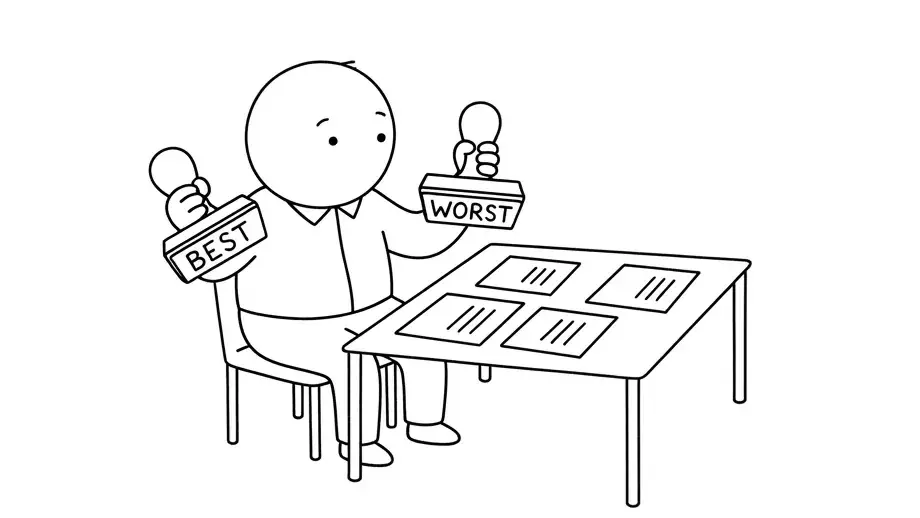
The ACC exam is a 60-question knowledge-based test: single best answer, 90 minutes. The PCC and MCC exam is different. You read a coaching scenario and select both the best and the worst response from four options, and both answers count toward your score. ICF launched a new PCC-MCC Exam on November 10, 2026 (80 items, 150 minutes). The earlier 78-item version stays available through March 31, 2027.
The three questions below come from the 10 free practice questions everyone gets with a free CredentialPrep account, in the PCC/MCC best-and-worst format, since that's also the format that maps most directly to ICF's coaching framework.
Pick the best response and the worst response for each.
Question 1 (PCC/MCC)
Core competency: Establishes and Maintains Agreements
A regional sales manager was enrolled in a company-sponsored coaching program after a leadership assessment flagged his communication style and strategic thinking. His manager arranged the three-way kick-off and drove the conversation. The client sat quietly, nodding, while his manager set goals around executive communication, stakeholder management, and visibility. The client agreed to each one without pushing back or adding anything of his own. Now in the first one-on-one, he seems distant and disengaged. When the coach asks where he wants to start, he shrugs and says, "I guess whatever my manager thinks I need to work on."
What should the coach do?
A. Keep the manager's stated goals as they are and help the client find a personal connection to them.
B. Acknowledge the kick-off goals, then ask what matters most to the client about his own development.
C. Propose scheduling another three-way meeting so the client has more room to contribute to the goals.
D. Set the kick-off goals aside completely and ask the client what he wants to work on instead.
Sign up free to see the answer
Question 2 (PCC/MCC)
Core competency: Maintains Presence
A program director at a large nonprofit has been working with her coach for six sessions on questions of leadership identity and long-term direction. She is thoughtful and tends to answer questions quickly and thoroughly. In today's session the coach asked a question about her leadership legacy. A silence followed, now over a minute long. She is looking slightly past the coach, lips pressed together, clearly turning something over. The coach feels a strong urge to fill the silence, rephrase the question, or offer a prompt.
What should the coach do next?
A. Ask softly if they'd like you to rephrase or approach the question differently.
B. Sit with the silence and remain fully present. Let the client break it when they're ready.
C. Share that questions about legacy often surface deeper identity work, and that it can help to think about who they want to be remembered as by the people closest to them.
D. Offer an observation: "Something about that question really stopped you."
Sign up free to see the answer
Question 3 (PCC/MCC)
Core competency: Listens Actively
A vice president of product has been in coaching for three months on cross-functional collaboration. In today's session she has been describing a series of difficult team interactions for twenty minutes. Her account is even-keeled and analytical across most of the team. The coach notices something: each time she mentions one particular colleague by name, there is a brief pause before she continues, followed by a subtle quickening of pace. The pattern has appeared at least four times. She has not seemed aware of it.
How should the coach handle this moment?
A. Continue following the discussion and ask what the client wants to do about the team dynamic.
B. Name the pause and pace shift that appears each time she mentions this colleague, and ask what she is aware of.
C. Ask directly whether her relationship with that colleague is more difficult than the others.
D. Suggest she raise her feelings with the colleague directly.
Sign up free to see the answer
Get 10 free practice questions with full answers
See the correct answer, the worst answer, and a detailed explanation for every question, including the three above. No credit card, no subscription required to start.
Get 10 free questions (free signup)
About the ICF credentialing exams
The ACC credential has its own exam. PCC and MCC candidates take the ICF Credentialing Exam. Both are administered by Pearson VUE, either in-person or via remote proctoring.
ACC exam: 60 knowledge-based multiple-choice questions, 90-minute time limit, single best answer per question. Tests your understanding of the ICF Core Competencies, the Code of Ethics, and the definition and scope of coaching.
PCC-MCC Exam (launched November 10, 2026): 80 items in 150 minutes, with an optional 10-minute break. 44 are situational judgment items and 36 are knowledge-based multiple choice. In each situational judgment item you select the best response and the worst response from four options, and both answers count toward your score.
Earlier ICF Credentialing Exam (PCC/MCC): 78 situational judgment items, 3-hour time limit, same best-and-worst format. It stays available through March 31, 2027, and you can choose either exam until then.
What both exams test: all eight ICF Core Competencies across four clusters. Neither exam tests specific coaching models, methodologies, or tools. The exam is grounded in the ICF competency framework, not any particular school of coaching.
Practice questions: CredentialPrep has 460+ practice questions, 202 scenario-based and 261 knowledge-based, with a detailed answer explanation for every one.
These practice questions are written based on the published ICF Core Competencies and exam structure. The ICF credentialing exam is a registered trademark of the International Coaching Federation.
Related reading
- The worst-answer problem: why the ICF exam is harder than it looks
- The ethics trap: how candidates lose points on questions they think they got right
- The first 10 minutes of the ICF exam: what to do before you answer a single question
- Exam Prep: practice questions with an explanation for every answer