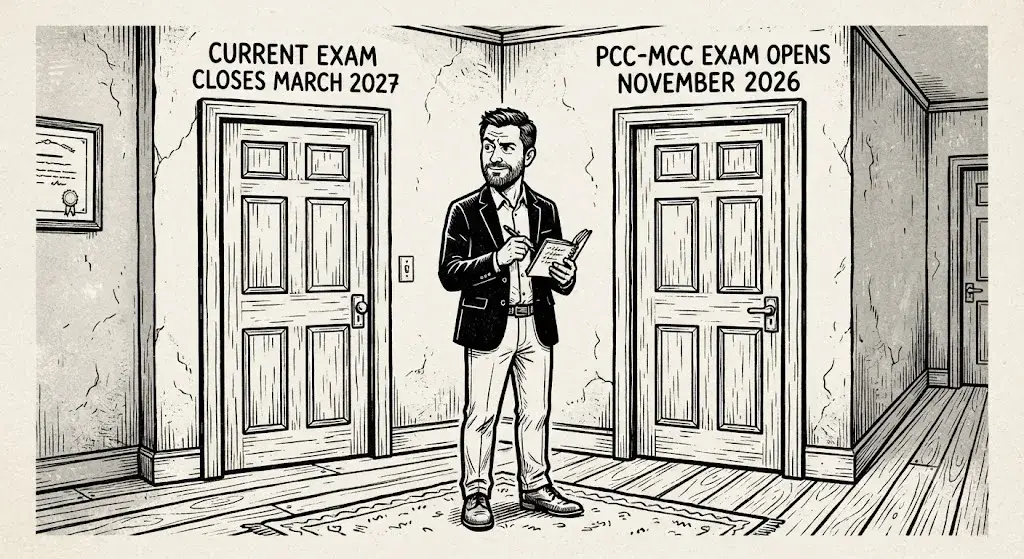
Heads up: This post describes the current PCC/MCC exam. A new PCC-MCC Exam launches November 10, 2026 with a different format: 80 questions in 150 minutes, and a new knowledge-based multiple-choice section. If your exam date is on or after that, see The New PCC-MCC Exam for what's changing.
A month out is when the panic usually shows up. You've read the competencies more than once. You've worked through practice questions. And somewhere in the last few weeks, the confidence you had at the start has turned into the opposite: a nagging sense that you don't know this material as well as you thought, that you're going to freeze, that some other version of you would pass this and the version sitting down at Pearson VUE won't.
I want to say something plain about that feeling, because I don't think the fix is what most candidates reach for.
The instinct to cram more is usually wrong
When people panic a month out, the reflex is to add. More flashcards. More re-reading of the Core Competencies. More scrolling through forums looking for the one explanation that finally makes it click. It feels productive, because you're doing something, and doing something is better than sitting with the fear.
But the exam isn't a knowledge test in the way a bar exam or a licensing exam is. You are not being asked to recall a fact under pressure. You're being asked to look at a coaching scenario and identify the response that is most aligned with the ICF framework and the response that would do the most harm. That's a judgment call, and judgment isn't something you build by adding more material in the final month. It's something you already have, from coaching real clients, that panic makes you doubt.
Your coaching instinct is closer to the answer than you think
The instincts that make you good in a real session are usually the same instincts the exam is scoring you on. Stay curious instead of assuming. Follow what the client said instead of where you'd like the conversation to go. Ask instead of tell. Notice when you're about to nudge someone toward your own conclusion instead of theirs.
If you've been coaching for any real length of time, you already do this, most of the time, without thinking about it. What panic does is make you stop trusting that. You start second-guessing the response that felt right and reaching instead for whichever option sounds the most impressively "coach-like." That's usually the wrong move. A response that sounds sophisticated but imposes the coach's agenda is a worse answer than a plain, curious question, even when the plain question feels too simple to be the "exam-correct" one.
I built a shorthand for this a while back, FOCAL and HINGE, because I noticed I was doing the same thing under pressure: overriding a decent instinct with an anxious one. FOCAL describes what the best answers tend to do: follow the client's lead, open space, stay curious, ask rather than tell, listen without judgment. HINGE describes what the worst answers tend to do: hide an agenda, impose direction, nudge toward an answer, grade the client, explain or lecture. It isn't a new framework to memorize this late. It's a fast way to check yourself against the instinct you already have, instead of a new instinct to build from scratch in your last few weeks.
What a month out should look like
If you're panicking right now, here's what I'd spend the next four weeks doing.
Stop consuming new material. If you've read the Core Competencies and the markers relevant to your level, you have what you need conceptually. Adding more reading at this point mostly adds more noise to second-guess yourself with.
Practice under real conditions, not to learn new content, but to rebuild trust in the calls you're already making. Time yourself. Sit with the discomfort of not being sure, and notice that your first instinct is right more often than the panic tells you it is.
When you get one wrong, don't just note the correct answer. Ask what made you override your first read. Most of the time the gap isn't knowledge. It's a moment where you talked yourself out of a good instinct because a different option sounded more polished.
And when the day comes, if a question makes you freeze, come back to the plainest version of the question you can ask yourself: which of these four responses follows the client, and which one is really about the coach. That question is closer to the exam's own logic than anything you could cram in the next four weeks.
You already know how to do this. The exam is not asking you to become a different coach for three hours. It's asking you to trust the coach you already are, on purpose, under pressure. That's a harder thing to do than memorizing one more framework, and it's also the thing that gets you through.
If you want to practice that trust before exam day, try a few free questions and notice how often your first instinct was right.