
Heads up: This post describes the current PCC/MCC exam. A new PCC-MCC Exam launches November 10, 2026 with a different format: 80 questions in 150 minutes, and a new knowledge-based multiple-choice section. If your exam date is on or after that, see The New PCC-MCC Exam for what's changing.
I got this wrong early in my prep, and I want to save you some time.
When I started working through PCC/MCC practice questions, I treated the best and worst picks as roughly equal tasks. Find the strongest response, find the weakest, move on. That is not how the exam works, and it is not how the scoring plays out.
The worst answer is its own skill, and in my experience it is harder to identify reliably than the best. Here is why.
The best answer is usually recognizable
When you have internalized the ICF competency framework well enough to sit the exam, the best answer tends to have a signature. It is the response that follows the client's language, keeps the agenda with the client, resists the urge to interpret, and asks rather than tells. There may be two candidates that look close, but one of them usually has a small tell: a bit more agenda-pushing, a soft hypothesis slipped in, a question that contains its own answer.
With practice, you start to pattern-match on "most ICF" quickly. It is not automatic, but it is learnable in a way that feels like vocabulary building. You add examples to your internal model and the model gets better.
The worst answer is a different problem
The worst answer is not just the least-ICF response in a list of four. It is the response that does the most harm to the client or to the coaching relationship, given the specific situation in the scenario.
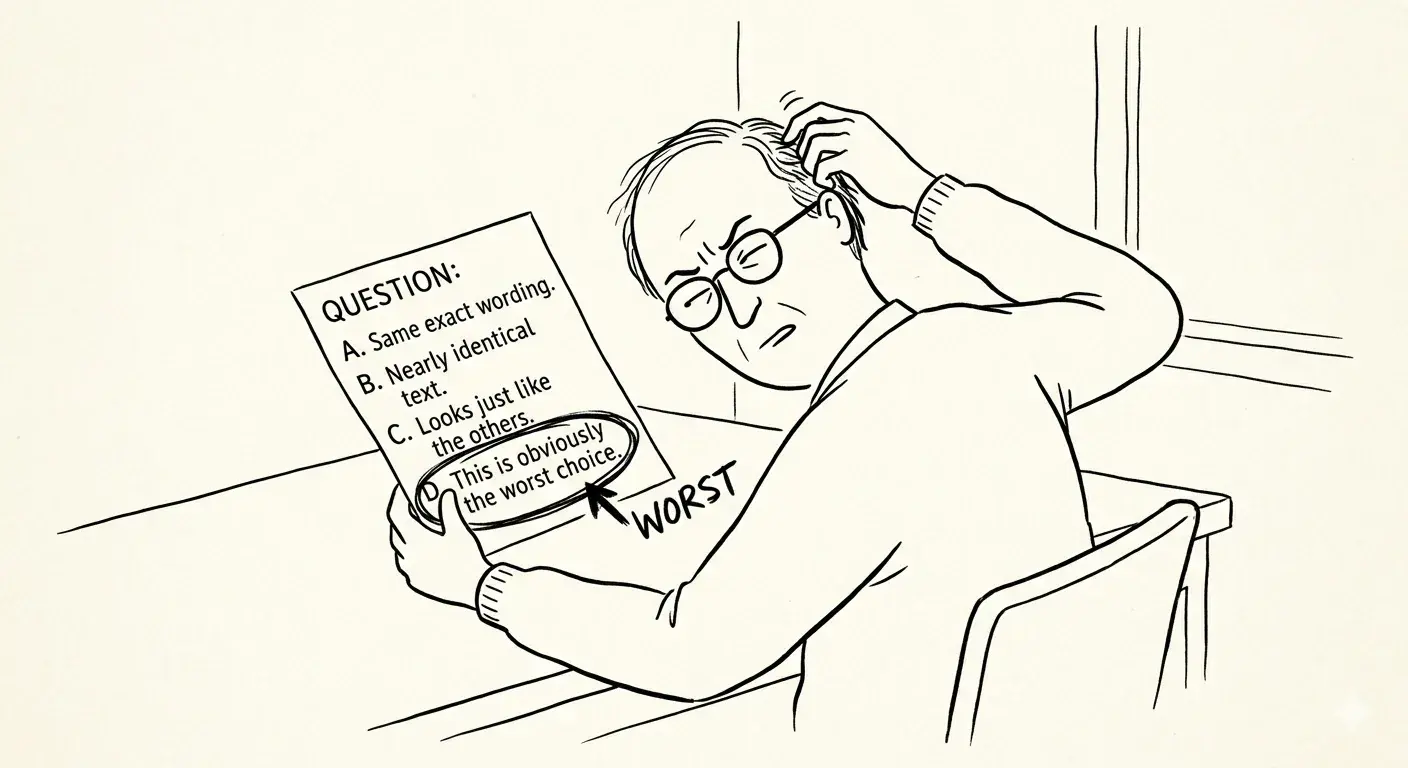
That sounds simple, but it creates a real complication: all four answers in a well-constructed scenario are coaching moves. Nobody is listing "tell the client their problem is boring" as an option. The worst answer is usually a plausible coaching behavior that is directionally wrong in a way that compounds whatever difficulty the client is already in.
Which means you have to rank harm, not just recognize it.
Option D sounds bad. But does it do more damage than Option A? Option A dismisses the client's stated priority. Option D imposes a structure the client didn't ask for. Which one violates client autonomy more? Which one closes a door the client might need later?
That judgment call, made under time pressure, with four options that each have some defensible coaching logic behind them, is where points get lost.
Why the worst is also where the test gets interesting
The exam uses the worst-answer requirement to test something the best-answer question cannot: whether you can hold two things in mind at once. The first is what good coaching looks like. The second is what specific kinds of not-good coaching are more harmful than other kinds.
Both of those require a clear model. But they require different applications of it.
Picking the best answer asks: given this scenario, what is the coaching move that most honors the client's autonomy, most reflects the ICF principles, and does the least harm?
Picking the worst answer asks: of the remaining options, which one would actively undermine the client, not just fail to help them?
That second question requires you to understand harm as a spectrum. A response that is slightly directive is not the same as a response that overrides the client's explicit statement. A response that misses the emotional content is not the same as a response that projects an interpretation onto the client as if it were fact. The worst answer is usually the one that does the most of the bad thing, not just a little of it.
What I've started doing in practice
When I get to a question now, I do the best-answer search first, which is usually faster. Then I go back to the remaining three and ask a specific question about each one: what does this response take from the client?
Every option is wrong in some sense. What matters is what it costs the client if the coach does this. Costs their autonomy. Costs their stated direction. Costs the trust in the room. Costs their ability to think clearly about their situation.
The answer that costs the most, in the context of what the specific scenario establishes, is the worst.
That framing changed how I practice. I stopped looking for the most obviously bad response and started looking for the most harmful one. They are often not the same thing.
The practice questions in CredentialPrep's PCC bank are built with this in mind. The debriefs explain not just what the best answer does right, but what the worst answer does specifically wrong, and why it is worse than the other near-misses in the set. If you want to build the muscle for ranking harm, that is the practice.
For the full prep framework, How to Pass on the First Try covers how to study diagnostically from the start. For day-of pacing and the two-answer problem, Exam Strategy for the Day You Sit It has specific guidance on what to do when you get stuck.