
Heads up: This post describes the current PCC/MCC exam. A new PCC-MCC Exam launches November 10, 2026 with a different format: 80 questions in 150 minutes, and a new knowledge-based multiple-choice section. If your exam date is on or after that, see The New PCC-MCC Exam for what's changing.
This is one of the most common questions coaches ask when they are mapping out a long-term credentialing plan: is the MCC exam different from the PCC exam? Will I have to study a different set of material when I move up?
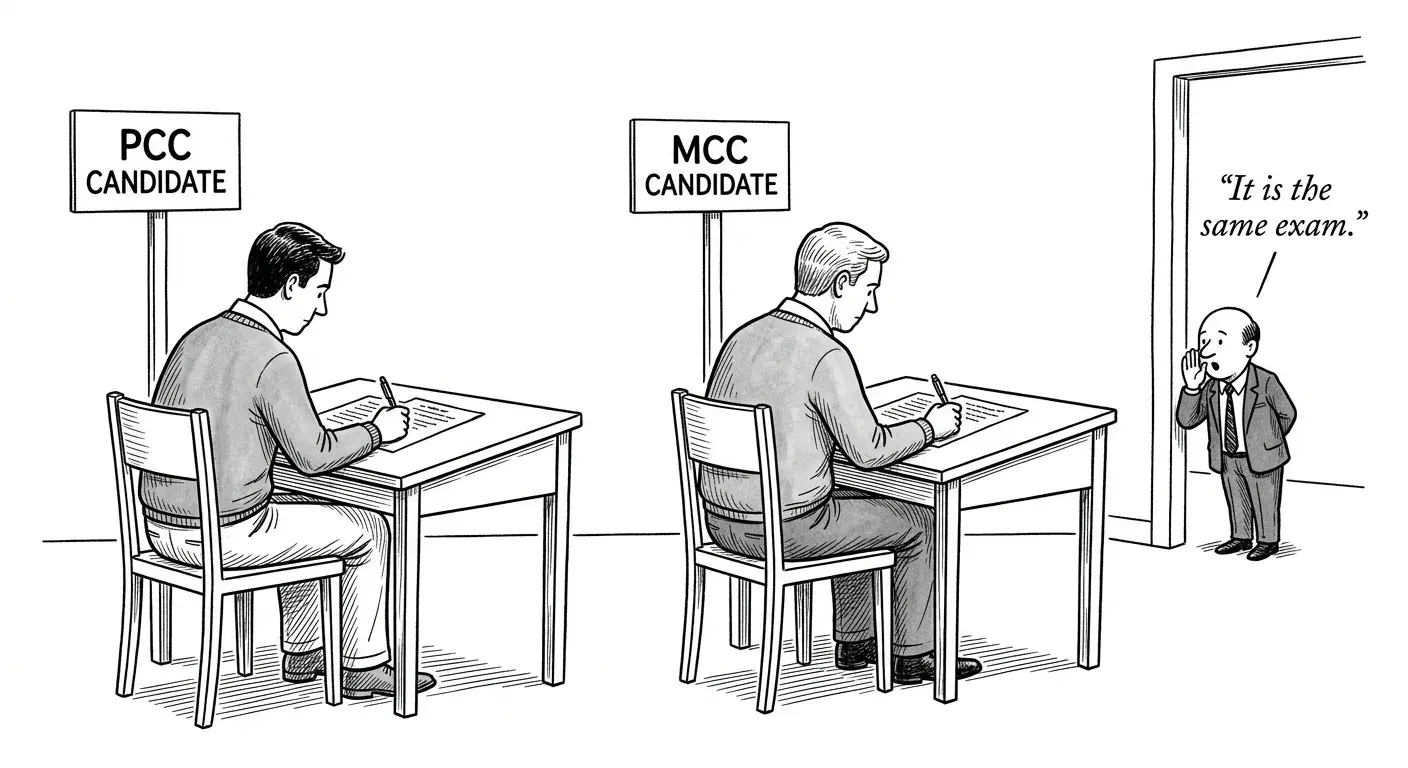
The short answer surprises most people. The written exam is the same for both credential levels, in both the current version and the new PCC-MCC Exam launching November 10, 2026. The credential level you are applying for does not change the exam you sit. What changes is everything else around it.
TL;DR
- PCC and MCC candidates take the same exam. Current format (through March 31, 2027): 78 situational judgment items, 180 minutes, best-and-worst. New format (from November 10, 2026): 80 questions in 150 minutes with a knowledge-based section added. See The New PCC-MCC Exam.
- The exam is required once. If you passed it for PCC, you do not retake it for MCC.
- The ACC exam is a separate, shorter test. ACC has its own format (60 questions, single best answer, knowledge-based).
- What differs between PCC and MCC credentialing is the performance evaluation markers, the hour thresholds, and the prerequisites. Not the written exam.
The ICF Credentialing Exam, in primary-source terms
ICF's own page for the current PCC and MCC exam describes the format clearly (this section applies to the current exam through March 31, 2027; the new format is covered in The New PCC-MCC Exam). The exam contains 78 situational judgment items. Total exam time is 180 minutes, including an optional 10-minute break midway. The exam is divided into two sections. Scoring is on a 200 to 600 scale, with 460 as the passing mark.
Both candidate guides (PCC and MCC) describe an identical exam. Same number of questions. Same time. Same format. Same scoring scale.
This is straightforward to verify by reading the PCC candidate guide and the MCC candidate guide side by side. The exam section is the same in both.
What the format means in practice
The exam presents coaching scenarios with four possible responses. For each scenario, you identify the most effective response (best) and the least effective response (worst), aligned with ICF competencies. You make two judgment calls per question.
The format tests judgment, not recall. You're evaluating coaching scenarios, not remembering definitions. Memorizing terms won't help you find the best-and-worst pick.
Note: the new PCC-MCC Exam launching November 10, 2026 will add a knowledge-based multiple-choice section alongside the situational judgment questions. See The New PCC-MCC Exam for how the two sections split.
The exam runs through Pearson VUE, either at a physical test center or online with a remote proctor. The same delivery system, the same software, the same item bank, regardless of whether you are applying for PCC or MCC.
You only take the exam once
This is the part many coaches miss when they are planning. The exam is required once, the first time you apply for a credential at PCC or MCC level. If you passed it as part of your PCC application, you do not retake it for MCC. You also do not retake it for renewals. It is a one-time bar.
The exception is if you are starting at MCC level without prior PCC. This happens occasionally with coaches who hold prior credentials from other federations, who completed extensive training before pursuing ICF, or whose PCC has been allowed to lapse. In those cases the exam is sat fresh, but the format is the same exam any PCC candidate would take.
So what is different between PCC and MCC credentialing?
The credential gap is real. It is just located in three places that are not the written exam.
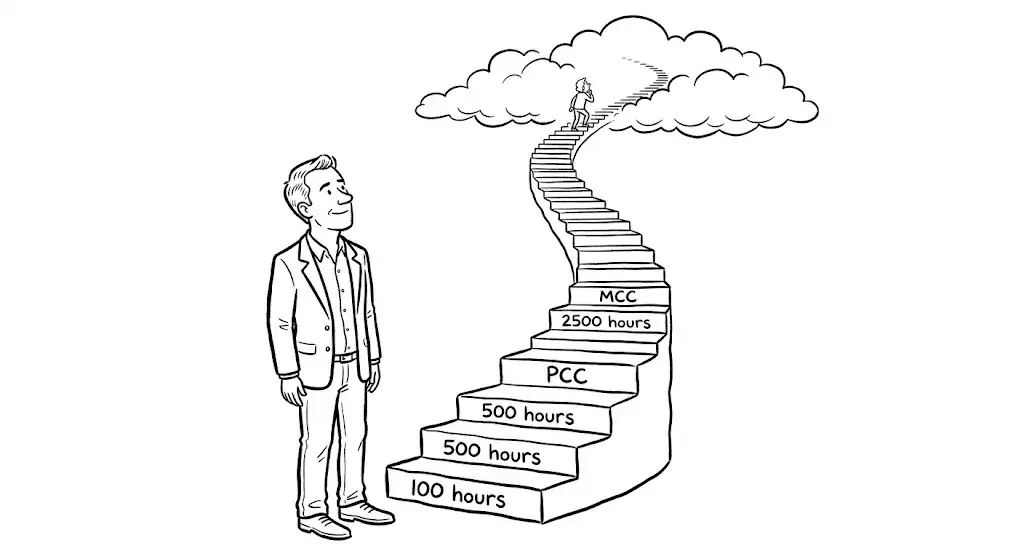
The hour threshold. PCC requires 500 coaching hours (450 paid). MCC requires 2,500 coaching hours (2,250 paid). The volume difference is the structural gate that takes most coaches years to clear, and it does not show up anywhere on the exam.
The performance evaluation markers. This is where the meaningful qualitative difference lives. PCC candidates submit one recorded session, evaluated against the PCC markers. MCC candidates submit two recordings, evaluated at a substantially higher standard.
The competencies are the same eight either way. The markers are the same documented behaviors. What changes is what the assessor expects to hear. At PCC level, the assessor is looking for evidence of coaching the "who" of the client, with the coach actively partnering. At MCC level, the assessor expects almost full client leadership of the session, with the coach holding presence and partnership at a level that takes years to develop. The MCC coach asks fewer questions. The questions land deeper. The session belongs more visibly to the client.
This is the gap most coaches underestimate. A strong PCC submission can be quite different in feel from a strong MCC submission, even though both are scored against the same eight competencies.
The prerequisite. You must hold or have previously held PCC before you can apply for MCC. There is no direct path. This rule is what produces the typical 8 to 10 year arc from first coach training to MCC eligibility for full-time coaches.
What about the ACC exam?
This is worth flagging because ACC and PCC use different exams, which adds to the confusion.
The ACC exam, mandatory since March 2025, is a separate 60-question knowledge-based test. The format is single best answer (not best-and-worst). The content split is approximately 30% ethics, 30% definition, 40% competencies, focused on recall rather than judgment. For the broader context on what changed and what is changing next, see ICF credentialing changes 2026 to 2027.
ACC and PCC/MCC are different exams, with different formats, different lengths, and different cognitive demands. ACC is knowledge-based and tests whether you know the competency framework. PCC/MCC is judgment-based and tests whether you can apply it under scenario pressure. For the deeper breakdown of how PCC/MCC scenario questions work, see What the ICF credentialing exam tests.
If you are planning to move from ACC to PCC, you will sit a different exam at the PCC stage. If you are moving from PCC to MCC, you have already taken the exam.
What this means for your prep
If you hold PCC and you are working toward MCC, your study time should go almost entirely to the performance evaluation rather than the written exam. The exam is behind you. The performance evaluation is the structural challenge of the MCC application.
If you are pursuing PCC and you know you eventually want MCC, study the PCC/MCC exam once and study it thoroughly. The investment pays for both credentials. For pacing your prep, see How long does it take to prepare for the ICF credentialing exam.
If you are pursuing ACC and planning to eventually pursue PCC, do not assume the ACC exam prepares you for the PCC exam. The formats and demands are different enough that ACC prep is largely separable from PCC prep.
Where CredentialPrep comes in
The exam bank on CredentialPrep is organized around the actual format of each exam. The ACC question set uses the single-best-answer format that mirrors the ACC exam. The PCC/MCC question set uses the best-and-worst format that mirrors the credentialing exam used at both PCC and MCC levels.
Because PCC and MCC sit the same exam, the same practice questions serve both candidate pools. There is no separate "MCC question set" because there is no separate MCC exam.
Try the PCC/MCC question bank if you are studying for either credential.