
The MCC is the credential fewer than five percent of credentialed coaches hold. There are reasons for that, and they are not all about skill. The hour threshold, the prerequisite, and the way the markers rise between PCC and MCC are all gates that take years to clear even if you are already a competent coach.
I am writing this from inside the MCC process. I hold PCC. I submitted my MCC performance evaluation recordings in April 2026, and I am continuing to work toward my MCC. My exam prep is ongoing. So what follows is a current view of what the credential asks of you, sourced from ICF and grounded in my own application.
TL;DR
- Prerequisite: you must currently hold or have previously held the ICF PCC credential.
- 200 hours of coaching-specific training from an ICF-accredited program (a 75-hour Level 3 program is the standard route for PCC holders).
- 2,500 coaching hours, of which 2,250 paid, across at least 35 separate clients.
- 10 hours of mentor coaching from an MCC-credentialed mentor, 3 individual minimum, within 18 months of applying.
- Performance evaluation: two recorded sessions scored against the MCC markers.
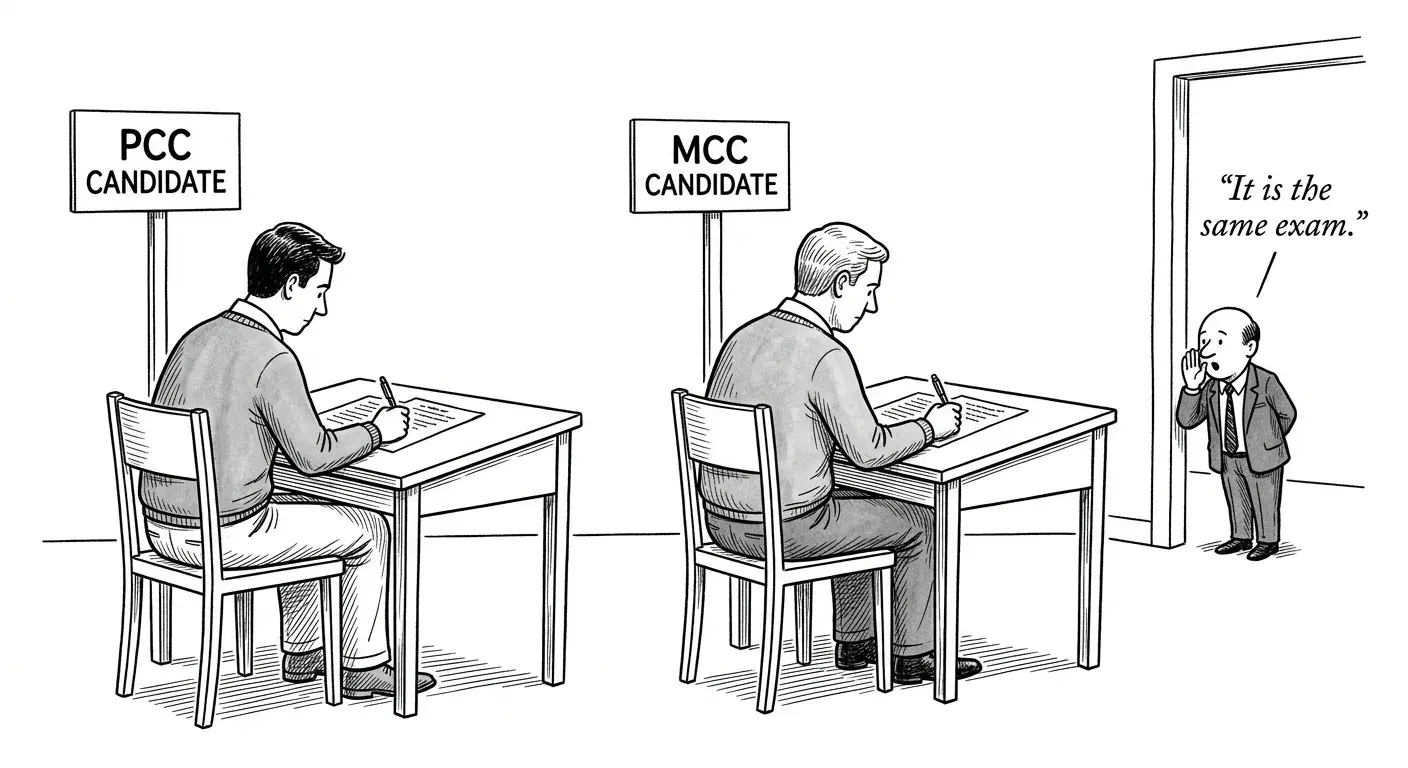
- The written ICF Credentialing Exam: 78 best-and-worst scenarios in 3 hours. This is the same exam PCC candidates sit.
The rest of this post walks through each piece. Where ICF has published a specific rule, I link it. Where I have an opinion based on my own application, I label it.
Prerequisite: PCC first
You cannot apply directly for MCC. You must currently hold the PCC credential, or you must have previously held it. This is non-negotiable, and it changes the timeline for everyone considering the credential.
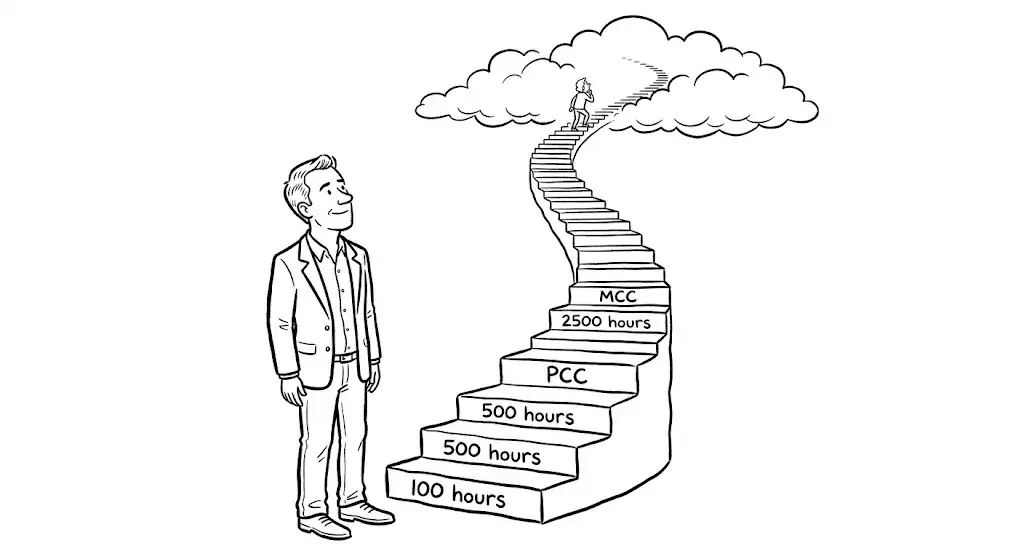
In practice that means the MCC clock starts after PCC, and the PCC clock starts after 500 coaching hours. So the typical sequence is: training, 100 hours and ACC (optional), 500 hours and PCC, then the climb to 2,500 hours for MCC. Most coaches arrive at MCC eligibility 8 to 10 years after they started coaching. For the credential-by-credential comparison, see ACC vs PCC vs MCC.
If you held PCC and let it lapse, that still counts toward the prerequisite. You do not have to currently be in good standing as a PCC, but you do have to have legitimately earned it.
Coaching-specific training: 200 hours
The MCC training requirement is 200 hours of coaching-specific education from ICF-accredited sources. Because PCC requires 125 hours, most coaches arriving at MCC eligibility need an additional 75 hours.
That gap is exactly what an ICF Level 3 program is built to fill. Level 3 programs are 75-hour advanced-curriculum offerings available only to existing PCC holders. They typically integrate the mentor coaching, the performance evaluation prep, and the additional training hours into one cohort experience designed specifically for the MCC pathway.
You do not have to take a Level 3 program. You can assemble the additional 75 hours from any ICF-accredited training that is open to PCC-level coaches. But the Level 3 designation exists because the alternative is more administrative work and more disconnected pieces. Most coaches choose the integrated path because by the time you are pursuing MCC, you already know how exhausting the documentation requirements are.
Coaching experience: 2,500 hours, 35 clients
The hour threshold is what makes MCC structurally rare. You need:
- 2,500 total coaching hours after the start of your coach-specific training
- At least 2,250 of those hours need to be paid
- At least 35 separate clients across your full coaching history
The math is sobering. At two paid coaching sessions per week, 50 weeks per year, you are logging 100 hours a year. To reach 2,500 hours requires sustained volume that most part-time coaches will never hit. Even full-time coaches working 15 to 20 coaching hours per week need roughly 3 to 4 years of consistent practice to clear the threshold.
The 35-client minimum is its own filter. You cannot reach MCC volume by working with five long-term executives. You need breadth, which usually means you are running an actual coaching business with intake and turnover, not a closed roster.
ICF logs hours through their member portal. The reporting is self-attested, with documentation available if requested. Inflating hours is an ethics violation.
Mentor coaching: 10 hours, MCC-credentialed mentor
You need 10 hours of mentor coaching from someone who currently holds the MCC credential. At least 3 of those hours must be individual one-on-one sessions. The remaining 7 can be in a group format with up to 10 participants.
The hours must fall within the 18 months before your application. Mentor coaching you did during your PCC prep does not count toward MCC unless it was MCC-level and falls inside the window.
There is one recent update if you are reading this in 2026 or later. Starting January 1, 2027, mentor coaches must hold the ICF Mentor Coach Specialization (MCS, formerly called MCQ) in addition to the MCC credential. The MCS is a separate qualification ICF rolled out to standardize mentor coaching quality. If you are planning to apply for MCC in 2027 or later, confirm that your mentor holds MCS at the MCC level before you book sessions.
My experience with mentor coaching: the difference between an MCC-level mentor and a PCC-level mentor is substantial. MCC mentors hear things in your recordings that you cannot hear yourself, and they say them plainly. Find one whose feedback makes you uncomfortable in a productive way.
Performance evaluation: two recorded sessions
For MCC, you submit two recorded coaching sessions. Each is between 20 and 60 minutes. Sessions are with real clients, recorded with consent, unedited, evaluated against the MCC markers.
The MCC markers are not a longer or harder version of the PCC markers. They are the same eight competencies, scored at a higher standard. The qualitative move is from coaching the "who" of the client (PCC) to almost entirely letting the client lead while the coach holds presence and partnership (MCC). The competencies that distinguish MCC most clearly in practice are coaching presence, evokes awareness, and partnership in setting and shaping the agreement.
What this means in a recording: the assessor is listening for a level of restraint that most coaches do not naturally demonstrate. The MCC coach asks fewer questions. The questions land deeper. The client is doing most of the substantive work, and the coach is creating the space for that work without rushing it or directing it. For my own notes on this from the inside of my MCC submission, see What I learned preparing my MCC submission. For the structural prep work that applies at every level, see How to prepare for the ICF performance evaluation.
Note on the 2026 update: ICF revised the skills requirements for performance evaluations submitted on or after January 1, 2026. The revision is largely about how partnership and client autonomy are demonstrated. If you are recording for MCC in 2026, work with a current MCC mentor who has seen the updated criteria. The credentialing changes between 2026 and 2027 post covers the bigger picture of what is moving and when.
The written credentialing exam
The ICF Credentialing Exam is required for MCC. It is the same exam PCC candidates sit: 78 scenario-based questions, 3 hours, best-and-worst format. You identify both the most effective response and the least effective response from four options. For the full breakdown of why "PCC exam" and "MCC exam" are the same test, see PCC vs MCC: are they the same exam.
If you already passed the exam for PCC, you do not retake it for MCC. The exam is required once, the first time you apply for PCC or MCC. If you have not sat it yet, How long does it take to prepare for the ICF exam breaks down realistic prep timelines.
For MCC candidates sitting the exam for the first time (which happens when coaches go directly from a non-ICF background to MCC via portfolio path, or when they let PCC lapse and re-enter at MCC level), the format is identical to the PCC version. Same 78 questions, same scoring scale, same Pearson VUE delivery.
The exam is harder than most people expect. The best-and-worst format means two judgment calls per question. The distractors are designed to catch coaches who default to consulting instincts or to "good-sounding" answers that are not the most client-led option. Working coaches with years of experience routinely find that their practical instincts point toward wrong answers, because the exam is built around a specific behavioral frame rather than around effectiveness.
Application fees and renewal
MCC application fees as of this writing: $675 for ICF members, $825 for non-members. ICF membership is $270 per year (verify at coachingfederation.org, since ICF adjusts pricing periodically). The membership math nearly pays for itself on the application fee alone, plus it lowers renewal costs.
Renewal cycle: every three years. To renew MCC you need 40 hours of Continuing Coach Education (24 in Core Competencies, 3 in Ethics) and a renewal fee. MCC holders are not required to repeat the 10 mentor coaching hours at renewal, which is one of the few breaks the credential structure offers at this level.
What surprises people about MCC
A few observations from my own application that I do not see written down clearly elsewhere:
The application paperwork is more involved than PCC. Documenting 2,500 hours and 35 clients takes serious time. If you have not maintained a coaching log from early in your career, reconstructing it is functionally impossible. Most coaches eligible for MCC have been logging hours in some form for years.
The two recordings are usually pulled from different time periods. Many candidates submit one recent recording and one slightly older one, to demonstrate consistency. Some assessors expect to see both pieces of evidence reflect current practice; others read consistency across time as a positive signal. Ask your mentor.
The review window can be long. ICF's own guidance points to several weeks for Level pathway and considerably longer for Portfolio path, and MCC submissions tend toward the longer end. I'm still in that window myself.
Where CredentialPrep comes in
The two parts of the MCC application that require active preparation are the performance evaluation and the written exam. Those are the two things CredentialPrep is built for.
The exam practice section has 202 PCC/MCC-format scenario-based questions, with full explanations for every answer. The transcript evaluation feature scores your coaching sessions against the ICF competency markers, which is useful for spotting the gap between "this session felt good" and "this session would meet the markers."
I built it because I needed both of those things for my own MCC application and what existed was not enough.
Try the question bank and see how the exam frame differs from how you coach in a paid session.