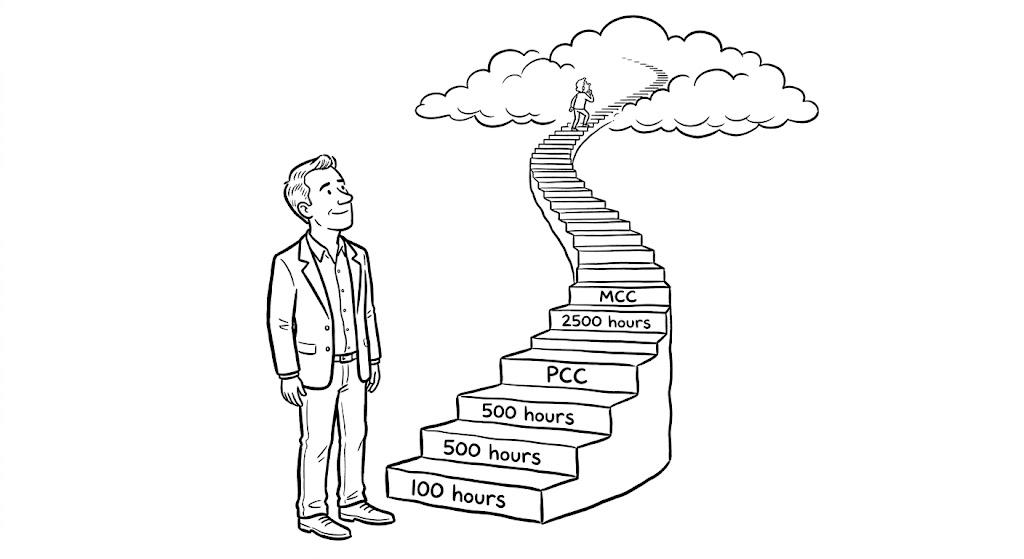
This is one of the most common questions coaches ask before they start preparing for the ICF credentialing exam: how long is enough? And underneath that question is usually another one: am I behind?
The honest answer depends on three variables, and most of the generic timelines published online ignore at least two of them. Below is what I would tell a coach starting from each likely starting point, based on prepping for my own exam and reading what coaches consistently report works.
TL;DR
- Recent ICF-accredited training, exam is fresh in your head: 4 to 6 weeks of focused study, roughly 5 to 8 hours per week.
- Training was 1 to 3 years ago, or you have drifted toward your own coaching style: 8 to 10 weeks, 5 to 8 hours per week.
- Training was longer ago, or you came up outside an ICF frame: 10 to 12 weeks, possibly longer.
- The single best predictor of readiness is how comfortable the best-and-worst format feels under timed conditions, not how many hours you have studied.
The three variables that determine your timeline
How long you actually need depends on:
- How recent your training is. ICF-aligned vocabulary and the competency frame fade if you have not been actively studying them. Coaches who just finished a Level 1 or Level 2 program are working with hot material. Coaches a year out are working with notes.
- How aligned your day-to-day coaching is with the ICF frame. If you coach in a style that prioritizes reframes, advice, or psychoeducational content, your real-world instincts will work against you on the exam. Re-calibration takes more time than starting from scratch.
- How much you can study per week. Most working coaches can sustain 5 to 8 hours per week of focused study. Going much higher tends to produce diminishing returns because the work is cognitive, not volume-based.
Recent training, fresh material: 4 to 6 weeks
If you just finished an ICF-accredited program, the competencies are loaded into working memory and the vocabulary is current. Your study time is largely about getting comfortable with the exam format itself.
For PCC or MCC candidates, the format is 78 best-and-worst scenarios in 3 hours. For ACC candidates, the format is 60 single-best-answer questions, primarily testing recall of the competencies, ethics, and definitions. The deeper breakdown of how the PCC/MCC questions are constructed lives in What the ICF credentialing exam actually tests, and the level-by-level comparison is in ACC vs PCC vs MCC.
A realistic 5-week plan at this starting point looks like:
Week 1: Format orientation. Read the ICF Core Competencies, the PCC Markers (for PCC/MCC) or the Code of Ethics (always). Work through the 8 official PCC/MCC sample questions or the 10 official ACC sample questions. The goal here is not study volume. It is registering what the exam actually looks like on the page. For why ICF gives you so few official samples, see Why there are only 8 official practice questions.
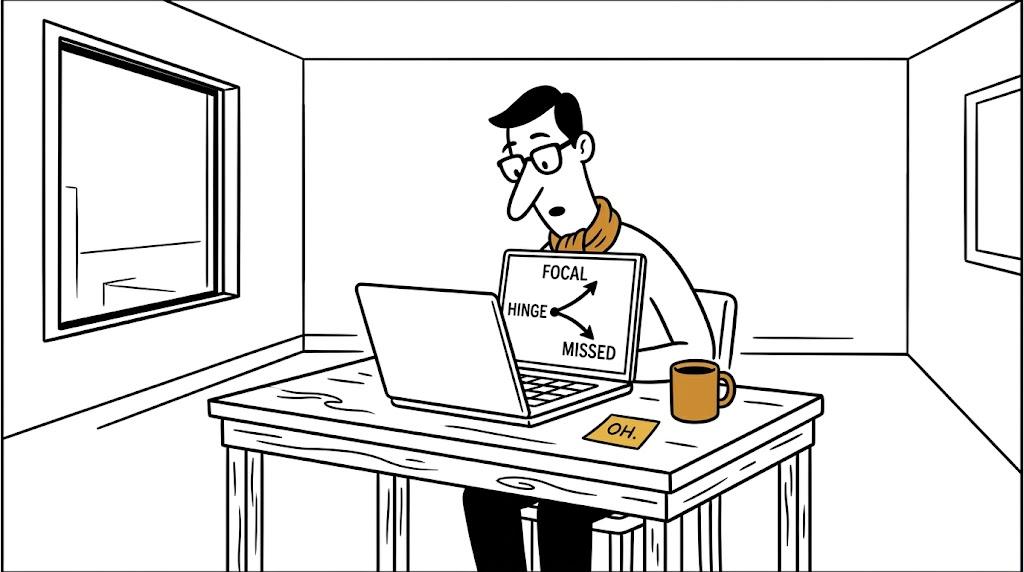
Week 2 to 3: Scenario practice. Move into bulk practice questions. For the best-and-worst format, your goal is not to pick correctly. Your goal is to notice the patterns that distinguish the four options. Most coaches start treating the format as a single-pick question (find the obvious right answer) and discover that this approach scores poorly. The best-and-worst format rewards a different way of reading. The FOCAL/HINGE framework is what I use to read every option quickly.
Week 4: Targeted weak-area work. By this point you should know which competencies trip you up. Ethics for some coaches (see The Ethics Trap), presence and active listening for others. Focus practice in those areas specifically.
Week 5 to 6: Timed simulations. Run full-length practice sets under timed conditions. The PCC/MCC exam gives you 3 hours for 78 questions, which works out to roughly 2 minutes per question with two judgment calls each (best and worst). Sitting an entire 78-question simulation in one block is uncomfortable and informative. The discomfort is part of the prep.
Training 1 to 3 years ago: 8 to 10 weeks
If your training was a year or more back, add 3 to 4 weeks to the front of your prep for re-immersion. You are not learning the competencies for the first time, but you are recovering the muscle memory.
Weeks 1 to 3: Re-read the competencies and markers slowly, with examples. Re-watch any training-program materials you still have access to. Notice where your current coaching has drifted from the framework. This is not exam prep yet. This is restoring the conceptual base.
Weeks 4 to 8: Move into the same plan above. Format orientation, scenario practice, weak-area work, simulations.
Weeks 9 to 10: Buffer. Sit one or two full timed simulations the week before your scheduled exam. If you find you are still missing the same pattern repeatedly, that is information. Either delay the exam or accept the gap and sit it.
Training longer ago, or non-ICF background: 10 to 12 weeks
This is the most common situation for coaches sitting the exam years after their training. Coaches who built their practice in a niche style (somatic, psychospiritual, Co-Active without the ICF mapping) often find their instincts do not match what the exam rewards. The re-calibration takes time.
The plan is the same as above, but with more weight on re-immersion and more practice volume in the middle phase. Plan for 8 to 10 hours per week if you can sustain it, because you are doing two things at once: learning the framework as material and unlearning your default reading of coaching scenarios.
One pattern to watch for at this starting point: the exam will repeatedly punish answers that are warmer, more relational, more therapy-adjacent. Coaches with a counseling or somatic background often pick those answers from genuine craft, and the exam considers them less effective than the cleaner, more client-led options. The recalibration is real, and it takes practice rounds to land.
What "studying" should actually look like
A point that surprises coaches preparing for the first time: reading is not studying. Re-reading the competencies for the eighth time is not preparing you for the exam. What prepares you is practicing the act of reading a scenario and identifying the best-and-worst pick.
The breakdown of effective study time, in my experience:
- 10 percent reading and re-reading source documents (competencies, markers, ethics code)
- 60 percent working scenario questions and reviewing why answers are scored the way they are
- 20 percent targeted weak-area drilling
- 10 percent timed simulations
If you find yourself spending most of your study time re-reading, you are studying for the wrong exam.
Signs you are ready
You are ready when:
- The best-and-worst format feels natural. You read a scenario and the four options sort themselves quickly.
- You consistently identify the worst answer with confidence. (Often harder than the best. See The Worst-Answer Problem for more on this.)
- You can articulate why a "good-sounding" answer is not the best. The exam is built around distractors that sound coach-like and miss the competency in subtle ways.
- Your timed simulations are landing in roughly your target score range.
You are not ready when:
- You are still surprised by what the exam considers the best answer.
- You are scoring inconsistently across simulations (one strong, one weak).
- You can identify the worst answer only when it is obvious.
- You are still re-reading the competencies hoping they will click.
When to schedule the exam
Schedule the exam at the start of your prep, not at the end. Choose a date 5 to 8 weeks out based on your starting point. The deadline makes the work concrete, and the Pearson VUE scheduling system gives you reasonable rescheduling flexibility if you genuinely need it.
Coaches who do not schedule a date often stretch their prep indefinitely because there is always another competency to re-read or another practice set to work through. The deadline forces the simulation phase to happen, which is the only phase that tells you whether you are actually ready.
A note on retakes
If you sit the exam and do not pass, the retake fee is $105. You can sit again 14 days after your first attempt; subsequent retakes require a 30-day wait, with a cap of six attempts per year. Most coaches who retake pass on the second attempt, often because the first sitting served as the most accurate diagnostic of what they needed to study.
This is not a recommendation to plan on retaking. It is a recommendation to not let fear of failure delay sitting the first time. The waiting period is short, and the second attempt is informed by direct experience of what the exam felt like.
Where CredentialPrep comes in
The middle phase of any prep plan is bulk scenario practice with explanations. That is the gap CredentialPrep is built for. The question bank has 460+ scenario-based questions in the formats that match the ACC and PCC/MCC exams, with full debriefs for every answer.
I built it while preparing for my own MCC exam. The timed simulation feature is what I personally use to gauge readiness, and it is the closest you can get outside of sitting the actual exam.
Start with 5 free practice questions and see how the format reads to you. That alone will help you estimate how much prep time you actually need.