
Most of the "ACC vs PCC vs MCC" posts on the internet are lists of requirements you could pull from the ICF site yourself in five minutes. I'll give you the requirements too, because they're useful and I'd rather you have them in one place. But I'm also going to tell you what's different between the levels from inside the process, because I happen to be in it.
Quick context before we start: I hold PCC and I'm preparing my MCC application right now. I've done the hours, I've done the mentor coaching, I've recorded (and re-recorded) sessions, and I'm close to submission. So when I say something about what each level is like in practice, it's coming from my current experience, not speculation. Where I have an opinion, I'll label it. Where something is a verifiable fact from ICF, I'll link it.
The requirements, from ICF directly
These are pulled from the ICF credentials overview and the experience requirements page. If anything here is out of date by the time you're reading it, trust the ICF site over me.
ACC (Associate Certified Coach)
- Coach-specific education: 60+ hours from an ICF-accredited program
- Client coaching experience: 100+ hours, with at least 75 paid, across at least 8 clients
- Mentor coaching: 10 hours over at least 3 months with a qualified mentor coach
- Performance evaluation: 1 recorded session, evaluated against the ICF Core Competencies at the ACC level
- Credentialing exam: Yes (the ACC version is 60 questions, 90 minutes)
PCC (Professional Certified Coach)
- Coach-specific education: 125+ hours from an ICF-accredited program
- Client coaching experience: 500+ hours
- Mentor coaching: 10 hours over at least 3 months with a qualified mentor coach
- Performance evaluation: 1 recorded session, evaluated against the PCC-level markers
- Credentialing exam: Yes (the PCC/MCC version is 78 questions, 3 hours)
MCC (Master Certified Coach)
- Prerequisite: Current PCC credential
- Coach-specific education: 200+ hours
- Client coaching experience: 2,500+ hours
- Mentor coaching: 10 hours with an MCC mentor coach
- Performance evaluation: 2 recorded sessions, evaluated at the MCC level
- Credentialing exam: Yes (same format as PCC)
Those are the hard facts. Also worth knowing: on October 9, 2025 ICF released updated Minimum Skills Requirements documents for ACC and MCC, effective January 1, 2026. PCC requirements themselves didn't change, but the document format was standardized across all three levels. Anyone evaluating a recording on or after January 1, 2026 is using the updated MSRs. Go read the one for your level.
Now the actual question
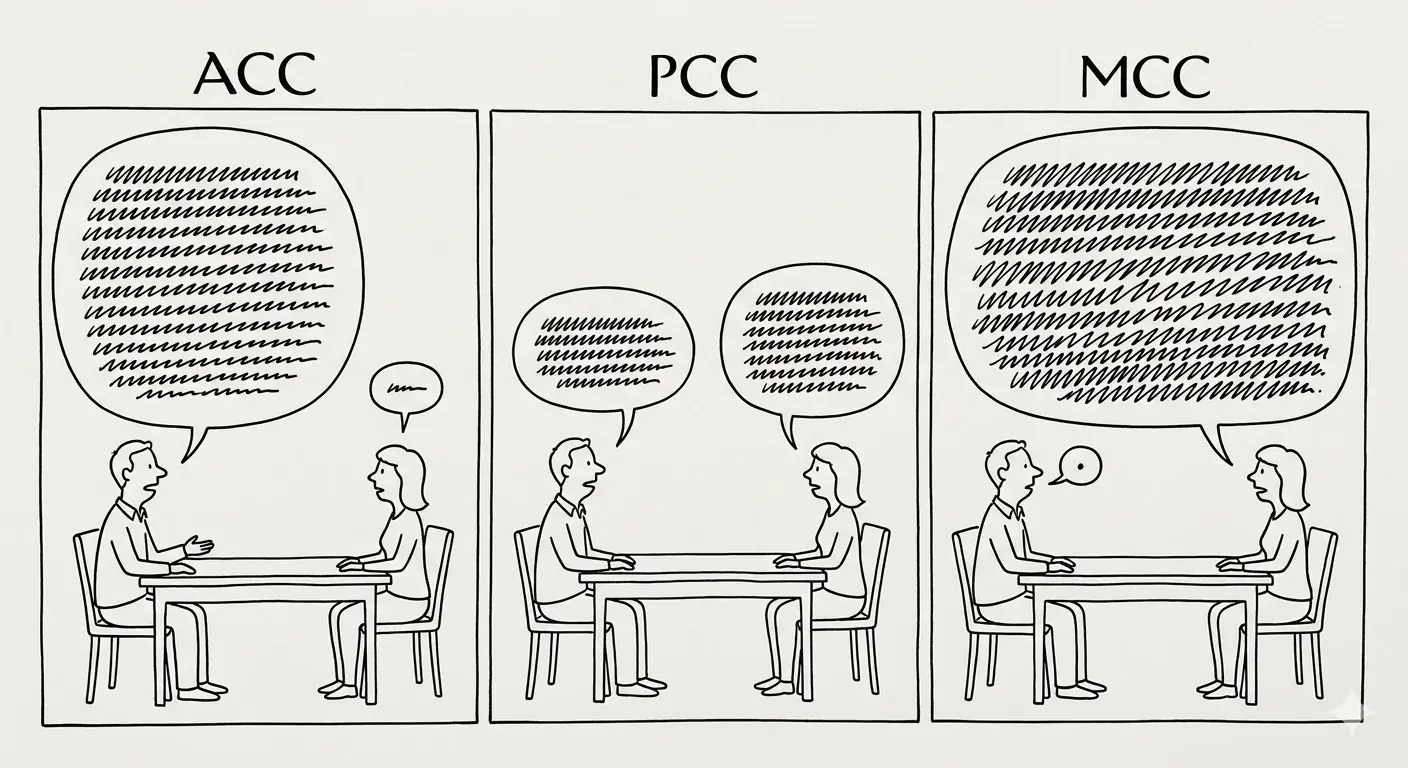
Here's what the requirements don't tell you. Once you have the hours and the training, the actual difference between ACC, PCC, and MCC comes down to what the rubric is checking for, rather than how hard the coaching is.
I'll try to describe this in plain language based on what I see in the PCC Markers document and in the training materials I've spent time with. This is my read, not ICF's official framing.
At ACC, the rubric is checking whether you can coach without making the beginner mistakes. Did you set an agreement? Did you ask open questions instead of leading ones? Did you stay out of advice-giving and consulting mode? Did you reflect reasonably accurately? ACC is a clearly defined bar, even if it isn't a low one. Most of it is about what you don't do.
At PCC, the rubric assumes you can do all of the above and is looking at something else. Look at the actual PCC markers. "Coach partners with the client to identify or reconfirm what the client wants to accomplish in this session." "Coach allows for silence, pause or reflection." "Coach asks clear, direct, primarily open-ended questions, one at a time." The word "partners" shows up a lot. So does "the client." The rubric is carefully asking: who is doing the work in this session?
At MCC, which is the one I'm working through right now, the bar rises again in a way I've found hard to name. MCC candidates submit two recordings instead of one, which tells you something on its own: the standard is about consistency and depth across sessions, not any single brilliant move. You can't fluke your way through two recordings. Whatever the first one shows about how you're coaching, the second one has to show too.
What I've found, practically, is that the distance between my "good PCC" sessions and what I think of as MCC-level sessions is about how little I'm doing, not how much. The sessions I'd be willing to submit at MCC are ones where I was almost invisible, the client did nearly all the work, and what little I said had an unusual amount of air around it. I'm still calibrating what that means and whether my own ear for it is trustworthy. That's what my mentor coach is for.
The partnership word does a lot of work
If you read the PCC markers quickly, it's easy to skim past "partners with the client" as filler language. That word is doing most of the work.
In a paid session, "partnering" can look like a lot of things. You might share your observation and ask what the client makes of it. You might offer a reframe and check whether it lands. You might suggest a direction and invite the client to modify it. All of those things involve you, the coach, putting something on the table for the client to work with. Plenty of good coaching works this way. Plenty of clients love it.
But notice what "Coach partners with the client to identify or reconfirm what the client wants to accomplish in this session" is asking for. It asks the coach to explicitly work with the client to identify what the client wants. The starting point is the client's words, not the coach's guess.
This is a subtle thing and I think it's where a lot of experienced coaches get surprised. Your coaching can be effective and still not match what the markers are looking for, because "effective" and "marker-matched" aren't the same test. The rubric has a preference for moves where the content comes from the client and the coach is visibly helping them work with their own content.
This probably isn't how all real coaching should look, and I doubt ICF thinks so either. It is a specific definition of coaching that has to be demonstrable on a recording, and the markers are the way that definition gets operationalized.
Which one should you pursue
I'm not going to tell you which credential to go for, because the answer depends on where you are in your coaching and what you want it for. But here's a better question than "which one am I eligible for."
Ask: am I currently coaching in a way that would match the markers for the level I'm considering?
Not "am I a good coach." Not "do clients get value." Those are different questions and they matter for your practice but they're not what this evaluation is checking. The evaluation is checking whether your recorded session maps onto specific observable behaviors at a specific level.
If you're aiming at PCC and you've never listened to one of your own recordings with the PCC markers document next to you, you don't really know whether you're at that level yet. Most working coaches have a guess, and the guess is usually optimistic. Listening back and checking is the thing that tells you. For a complete breakdown of what PCC requires across each piece of the application, ICF PCC Requirements: The Complete Breakdown has everything in one place.
If what you find is that you're not quite there, that's fine. It's useful information. It tells you what to work on specifically (not "get better at coaching" but "notice when I stack two questions together" or "stop interpreting the client's words into different words"). And then you can record another session in a month and see if it's changed.
A note on the "PCC is what really counts" idea
You'll hear, in various corners of the coaching world, that PCC is the credential that really matters for working coaches. I don't know if that's true. It's true that PCC is more recognized than ACC in corporate procurement contexts that specifically list ICF credentials. It's true that some coach directories and ICF chapters put more weight on PCC. It's also true that plenty of successful coaches hold ACC for years and never pursue PCC because it doesn't match what they do.
The credential you need is the one your clients (or employers, or procurement contracts) expect you to have. If nobody you work with asks about it, none of them are the credential you need. If your target clients are in contexts where the PCC is explicitly required, that's the one. There isn't a universal answer.
A note on MCC, from the middle of the process
A few things I didn't expect when I started preparing my MCC application.
It's less about adding technique and more about subtracting you from the session. At PCC I felt like I was demonstrating partnership. At MCC the work has been about getting out of the way so completely that the client doesn't notice I'm steering, because I'm not. Most of the growth has been in what I've learned to not say.
The recordings don't get easier to choose. If anything, the more careful I've gotten about what MCC-level coaching looks like, the harder it is to pick a recording I'm confident in. Two recordings instead of one is a more honest test of whether your baseline is consistent.
The mentor coaching is the thing. I did the required 10 hours, and my mentor coach has been worth every minute. The self-doubt I've been sitting with at this stage is mostly managed by having someone whose judgment I trust when my own ear stops being reliable. If you're considering MCC and you don't have a mentor coach you trust at that level, that's the first piece to solve.
If you're a few years post-PCC and wondering whether to go for MCC: talk to an MCC mentor coach. They've watched people try, they know what the pattern of success and struggle looks like, and they're better positioned to tell you whether you're ready than any blog post (including this one).
What I'd do before committing to any level
If I were preparing for any ICF evaluation, here's my short list, in order:
- Read the Minimum Skills Requirements document for your target level. These are the new ones from October 2025. They're explicit about "Behaviors Consistent" and "Behaviors Inconsistent" with ICF standards, which is a faster way to calibrate your self-assessment than reading markers alone.
- Read the PCC Markers document (even if you're going for ACC or MCC, because the behavior language is clearer there than in any summary).
- Record a session this week and listen to it with the markers document next to you. Check off each marker as you hear it. Notice what's missing.
- Do this for three or four sessions, not just one. One session isn't a pattern. Four will tell you what you really do.
- Talk to a mentor coach who holds a credential at or above your target level. The 10 hours are required anyway and the feedback is where the actual growth lives.
That's the short version. Most of the work is in step 3 and 4, and it's free, and I notice a lot of coaches skip it.
The friction most prep advice skips
Here's a thing I've run into myself while preparing my MCC application, and I think it's worth flagging because most prep advice glosses over it.
"Just record more sessions" is great advice on paper. In practice, recording sessions is harder than it sounds. Real clients have to consent, and some don't want to be recorded at all even with a confidentiality agreement in place. Some agree and then something about knowing the mic is running subtly changes the session. Paid clients are paying you to coach them, not to be your practice tape. And even when you get a good recording, you can't ask for a do-over. You can't re-run the same moment three different ways to see which version of your question would have been cleaner. You definitely can't ask a client to "try saying that again so I can practice reflecting it without adding meaning."
Mentor coaching helps, but it's also a scarce resource. A good mentor coach is expensive for a reason: their hours are the most valuable feedback in the whole process. ICF requires 10 hours with a qualified mentor coach and you want to spend those hours on the things only a human at your level can catch. You don't really want to burn mentor time on the stuff you could have caught yourself with a sharper ear.
That's the friction CredentialPrep is trying to chip away at. Not replace either of those things. What the app gives you, specifically:
- A way to drill a specific coaching moment with a simulated client, over and over, without burning a real session or a mentor hour. When there's something you want to try differently, you can try it differently ten times in an evening.
- Fast transcript feedback against the published PCC markers, so if you're sitting on four or five of your own recordings and not sure which one to bring to your next mentor session, you can run them through and narrow it down. Show up to your mentor with a sharper question instead of an open one.
- Scenario practice for the credentialing exam, which is the part where there isn't even a client to record.
If you're not sure what the exam format actually involves, What the ICF Credentialing Exam Really Tests covers the best-and-worst structure and what trips candidates up.
What it doesn't replace: your mentor coach. Your real-client recordings. The ICF performance evaluation itself. What it adds is volume and iteration between the human conversations that really matter, plus a cheap way to work on specific things at 10pm on a Tuesday when you have an idea you want to try but no client and no mentor available.
If you want to see what any of that looks like, you can start with 10 free questions right now, no card required: try it here.