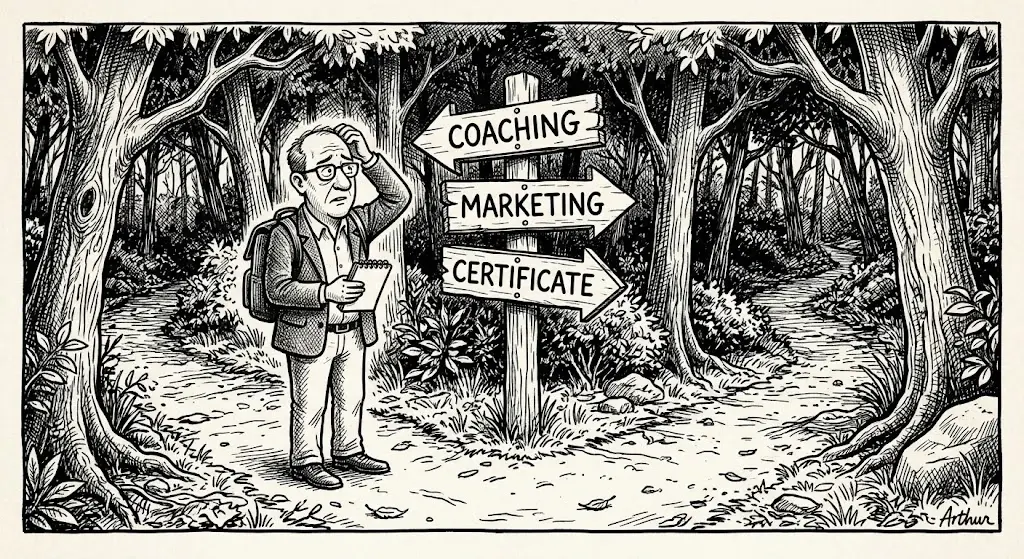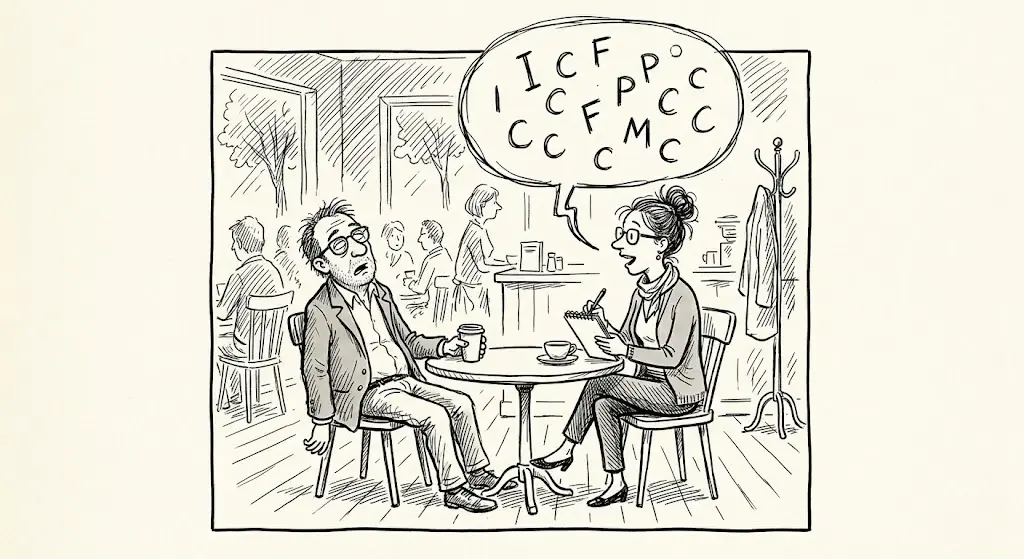

Say "ICF" to someone who found you through a friend, not through a directory, and watch nothing happen. Say "PCC" and you'll get a polite nod that means less than it looks like.
They're not being rude. Fewer than half of the working coaches on earth hold an ICF credential at all, 59,646 credential holders against 122,974 total practitioners worldwide, by ICF's own November 2025 numbers. If it's a minority position inside the profession, a private client outside it has no real reason to know what the letters mean, and no reason to feel bad about that.
What ICF's own guidance says moves people
This isn't a competitor's opinion, it's ICF's own consumer-facing advice on picking a coach. It lists chemistry and rapport as equally important as experience and qualifications, in a section literally titled red flags to watch for, and closes with a plain line: if something doesn't feel right, trust your gut and look for a coach who fits better. Connection, not credential level, is what the credentialing body itself tells consumers to weigh.
That tracks with research well outside coaching. The Nielsen Norman Group, which has studied how people read on screens for decades, has found the same pattern over and over in usability studies with real experts: "we've witnessed many instances of professionals being baffled by unfamiliar jargon," and interrupting a piece of writing to explain a term your reader already knows just alienates them. Unfamiliar language doesn't read as expertise. It reads as a wall.
"ICF," "PCC," "core competencies," whatever your training program was called: to someone outside the field, that's exactly the kind of jargon NN/G is describing. It signals nothing except that you're speaking a language they don't share.
What moves people instead
A specific outcome, stated plainly. Not "I use an evidence-based coaching framework aligned with ICF Core Competencies." Something closer to a sentence a stranger can picture, what changed for someone after working with you, said in words they already have.
A referral. Someone they already trust telling them it was worth it.
Chemistry on the first call, whether the way you listen feels like being listened to.
None of that has anything to do with your credential level, and dressing your bio up in acronyms probably costs you more than it earns.
So why bother getting credentialed at all
Because a different buyer is checking, and it isn't your private clients.
Employer-sponsored coaching platforms, where a company pays for coaching and picks the coaches from a roster, are a different buyer than a private client scrolling a directory. Some platforms, such as Torch, CoachHub, and Sounding Board, list an ICF credential as a requirement to join their coach network (check each platform's current rules), before a company ever reads a single bio. That's not a soft preference, it's the gate.
ICF's own 2025 research backs the money case up too. Credentialed coaches earn about $10,000 a year more on average than coaches without one, and 73% of coaches say clients and organizations increasingly expect it. That isn't your solo client scrolling a directory at 9pm. That's the corporate side of coaching, and it's a real, growing share of where coaching income comes from.
And starting in 2027, that path itself gets more structured. Every ACC and PCC candidate will need to work with a mentor coach who holds a brand-new credential of their own, the Mentor Coach Specialization, just to guide them through. For candidates on the Portfolio path, the old one-time recorded evaluation goes away too, replaced with an ongoing, observed mentor-coaching relationship. MCC keeps its recorded evaluation, that part isn't changing. Whatever the reasoning behind it, the practical effect is the same: getting credentialed is about to take more structure and more time than it does right now, which is its own argument for starting sooner rather than later.
What to put in your bio instead
Skip the acronyms and say the thing you'd tell a friend. Not "ICF-credentialed executive coach specializing in leadership development." Something closer to what a client would say afterward, in their own words, about what changed. That's the sentence that gets read, and the one that gets remembered.
The actual rule
Keep the acronyms out of the marketing entirely. Save the letters for the one place they're really being checked, and it isn't your website.
If you're working toward the credential for the reasons that matter and not the marketing ones, CredentialPrep has practice questions and a real transcript evaluation to help you get there.