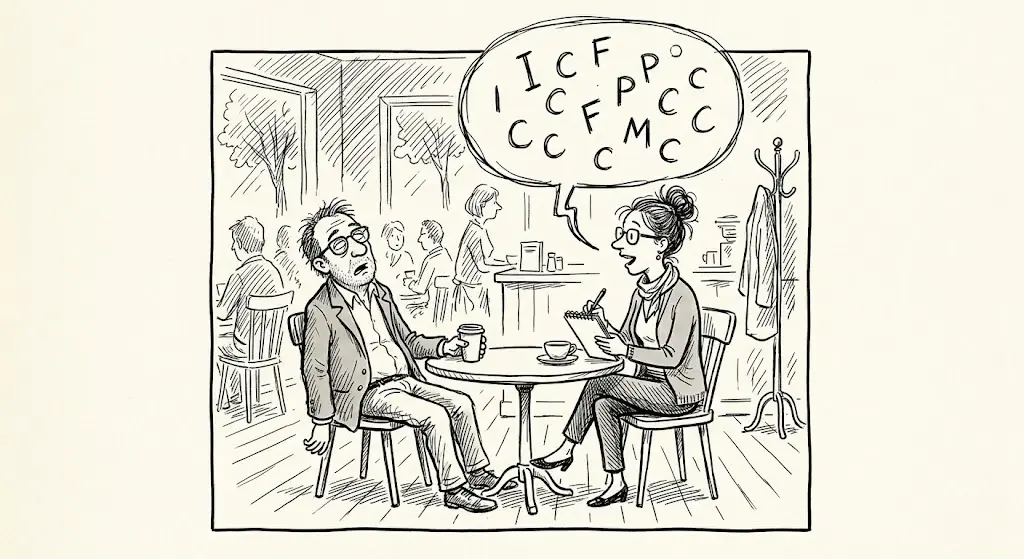

There are zero requirements to call yourself a coach. Anyone can put the word on a business card, no test, no license, nothing. I've believed that for years, and it's exactly why so many good coaches struggle while some mediocre ones do fine.
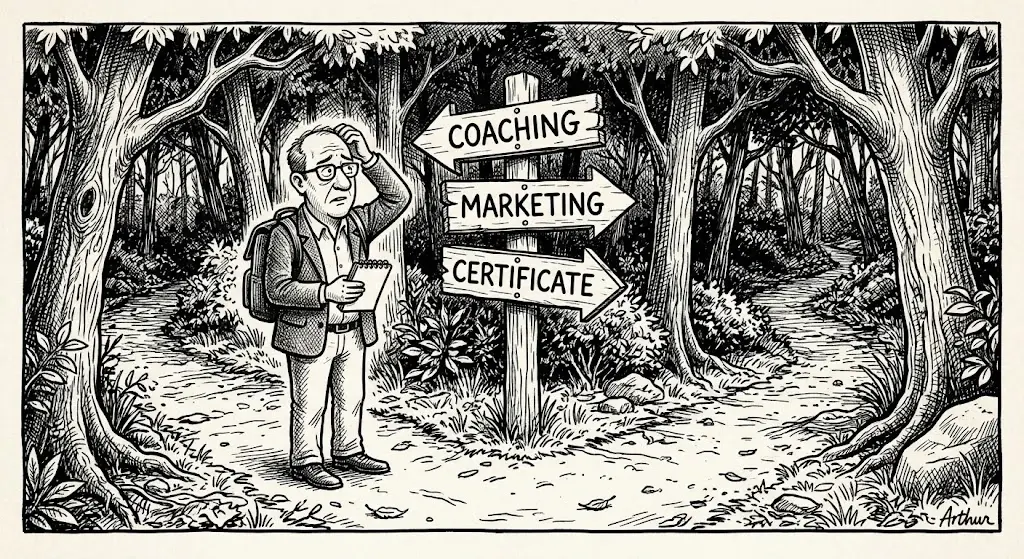
The reason isn't talent. It's that "being a coach" is three different jobs, and almost nobody trains for all three at once.
The three jobs
Coaching is the actual skill. Staying present with a client, asking the question that opens something up instead of closing it down, noticing what they aren't saying. It's a craft you build one session at a time.
Marketing is getting hired. Positioning, pricing, a way for a stranger to find you and decide to trust you with something real. None of that requires you to be a good coach. Plenty of people are excellent at it and mediocre coaches.
Learning to coach, formally, through training and credentialing, is a third thing again: a structured way to prove, on paper, that you understand a specific framework well enough to be tested on it.
The ICF Core Competencies, the actual framework the credentialing exam is built on, cover ethics, presence, trust, listening, evoking awareness, facilitating growth. Eight competencies. Not one of them touches pricing, positioning, or how a client finds you in the first place. That's a different subject entirely.
What the research says the exam measures
A study that tracked real coach-client pairs over two years, published in the Journal of Applied Behavioral Science, found six specific competencies that predict whether a client's behavior changes: the quality of the working relationship, empathy, emotional self-control, adaptability, and industry knowledge, among them. The same researchers said plainly that most coach training models were "identified through subjective means, such as opinion surveys, rather than empirical research linking specific competencies to coaching outcomes."
A separate 2023 meta-analysis in Frontiers in Psychology, looking across the whole body of workplace-coaching research, says outright that "very few studies include information about the coach's certification" at all. Credential status barely gets measured as a variable in the research on whether coaching works.
None of that means the exam is worthless. It means the exam tests a narrower thing than either of these two other jobs, and a narrower thing than the research says drives results with a client. Knowing the framework well enough to recognize it under time pressure is a real, checkable skill. It just isn't the same skill as building trust with a stranger in the first ten minutes, or getting that stranger to find you in the first place.
The two failure modes
A coach who's excellent in the room and invisible in the market. Nobody finds them. Their calendar has more empty slots than sessions, not because the coaching is weak, but because nobody outside their existing circle knows they exist.
And the opposite: a coach who's very good at getting hired, and once someone's in the room, doesn't have much to offer beyond warmth and good listening. That works for a while. It doesn't hold up under a real, hard problem.
Neither failure gets fixed by more training in the sense most coaches reach for. The instinct, when business is slow, is almost always another certification, another specialization, another framework for the website. If the actual gap is visibility, more training doesn't touch it. If the actual gap is depth in the room, a better logo doesn't touch that either.
Coaching didn't invent this gap, most solo professional-service businesses run into some version of it, but coaching makes it more visible because the same person is usually doing all three jobs at once: the coaching, the marketing, and often the ongoing training too, with nobody else on staff to cover the parts they're weak at.
What the credential proves
I wrote years ago that adjectives in front of the word "coach," executive, life, whatever, are marketing terms, not coaching terms. I still think that's true. A credential is closer to the opposite. It's the one part of "being a coach" that has an actual, testable standard behind it, even a narrow one.
The exam tests whether you can identify behavior that aligns with the ICF framework. That's a different question from whether you're an effective coach, and a different question again from whether anyone will hire you. It answers exactly one thing: do you understand the framework well enough to recognize it in a scenario, under time pressure, on a test.
That's useful to know about yourself. It just isn't the whole picture, and treating it like the whole picture is where I think a lot of coaches get stuck. Passing the exam doesn't fix an empty calendar. Building a beautiful brand doesn't make you better in the room. They're separate projects, and they need separate attention.
Which one are you solving
If your calendar's empty, that's a marketing problem, not a training problem, and no amount of additional coursework fixes it.
If you're closing clients but the work itself feels thin, that's a craft problem. It gets fixed by practice, feedback, and a clear-eyed look at your own sessions, not by a nicer website.
And if you're wondering whether you understand the ICF framework well enough to pass a real test on it, that's a third, narrower question, separate from either of the other two.
Knowing which one you're solving is worth more than another certification.
If it's the third one, CredentialPrep's practice questions come with a full explanation for every answer, not just a score.