
Heads up: This post describes the current PCC/MCC exam. A new PCC-MCC Exam launches November 10, 2026 with a different format: 80 questions in 150 minutes, and a new knowledge-based multiple-choice section. If your exam date is on or after that, see The New PCC-MCC Exam for what's changing.
When you start preparing for the ICF credentialing exam, one of the first things you do is look for official practice material. And you find it: a PDF on coachingfederation.org with sample questions. As of this writing, that PDF contains eight questions.
Eight.
For an exam that covers eight competencies, tests two judgment calls per question, and draws from a pool large enough that ICF warns candidates against sharing questions publicly because it would compromise the bank.
I want to explain why that number is what it is, and what it means for how you prepare.
Why the number is small by design
The ICF credentialing exam is not a knowledge test in the way most professional exams are. You are not being asked to recall a definition or identify which regulation applies to a situation. You are being asked to evaluate four coaching responses against each other and identify which is most aligned with ICF principles and which is most harmful.
Writing a good question for that exam is hard. Each scenario has to:
- Describe a specific coaching moment with enough context that the situation is clear
- Offer four responses that are all plausible enough to be tempting
- Have a defensible best answer that is not just obviously correct
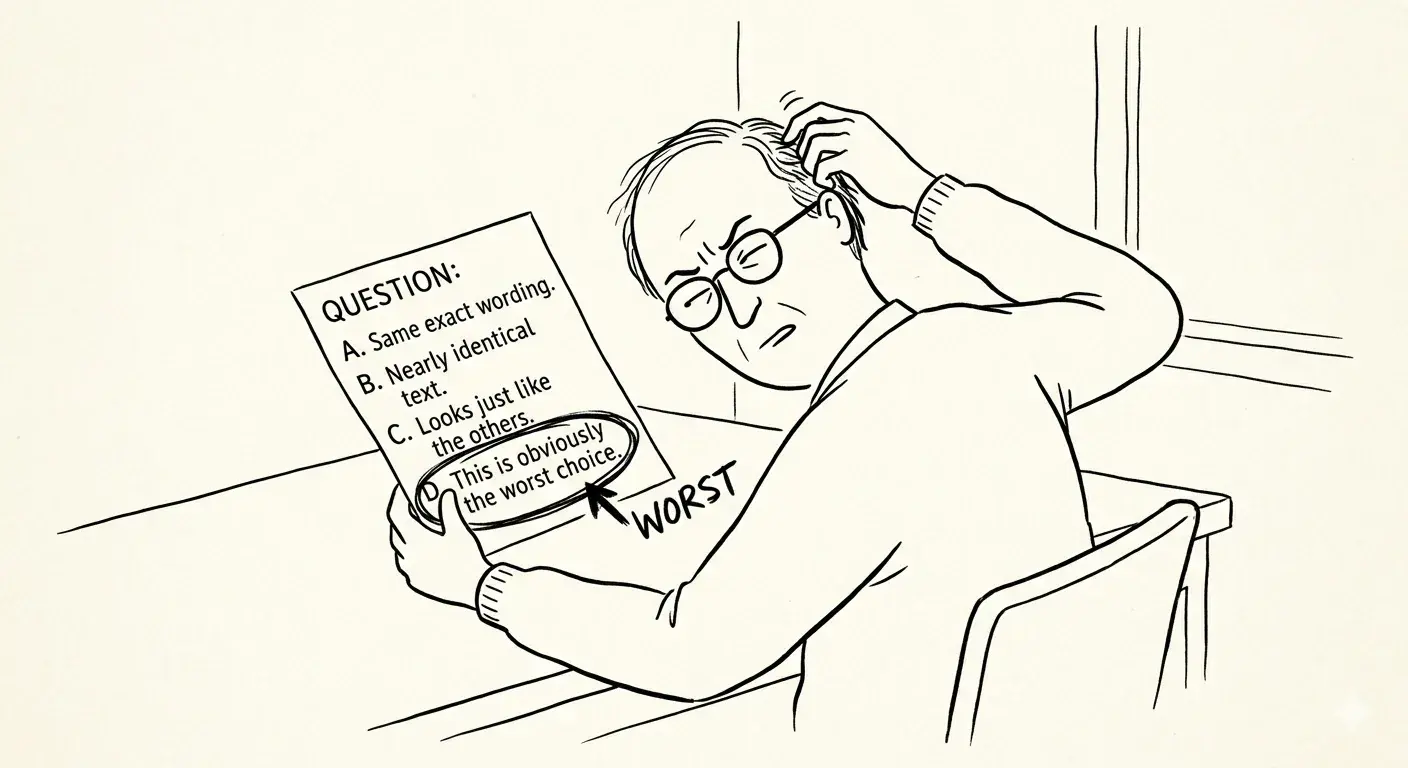
- Have a defensible worst answer that is not just obviously a joke option
- Avoid ambiguity that would make the question unfair
- Not overlap conceptually with adjacent questions in the bank
That is a different kind of test-writing than "which year did ICF found its Code of Ethics." It requires expert coaches who know the competency framework in depth, understand how real sessions fail, and can construct scenarios where the failure modes are adjacent enough to genuinely challenge someone.
ICF validates questions through a process that involves expert review. Items that do not pass validation get cut. A small number of validated, psychometrically sound questions is a different thing from a small number because nobody got around to writing more.
Why sharing the bank is a real problem
ICF has explicit language in its candidate materials about not sharing exam content. This is not boilerplate. If candidates share live questions, the questions that circulate become known, the bank gets contaminated, and the exam loses its ability to differentiate prepared candidates from candidates who memorized specific answers.
This is why official practice material is limited to sample questions rather than a representative slice of the actual bank. The sample questions are there to demonstrate the format, not to build your competency.
Eight questions demonstrates the format. It does not build the competency. The ICF Credentialing Exam: What It Really Tests goes into detail on what each question type is actually measuring.
What this means for prep
The scarcity of official material is not a reason to give up on structured practice. It is a reason to be careful about the quality of unofficial practice material, because that is what you are going to have to rely on.
There is a spectrum of prep options. At one end: free blog posts and competency framework summaries, which give you vocabulary but not reps with the judgment task. At the other end: expensive in-person programs from ICF-credentialed mentors, which give you the judgment training but cost significantly more.
In the middle: practice question banks built by people who know the framework well enough to construct valid scenarios and defensible answer keys. That is what CredentialPrep is.
AI-generated questions are increasingly part of this middle tier. The coaching community has generally received AI-generated exam questions as a legitimate prep tool when the questions are built on real competency knowledge and the answer keys are carefully reviewed. The question is not whether AI can write coaching scenarios. It clearly can. The question is whether the answer logic holds up under scrutiny.
That scrutiny is what distinguishes a useful practice bank from a set of plausible-looking questions with shaky answer keys. CredentialPrep's PCC bank was built question by question with that distinction in mind, and the AI Practice mode generates additional questions on demand, each built on the same competency framework.
The actual prep path
Given the scarcity of official material, the prep path for the ICF credentialing exam looks less like "study a textbook" and more like:
- Understand the competency framework deeply enough to have an internal model of what ICF coaching looks like versus what it does not
- Practice the judgment task, meaning best-and-worst selection, until it is fast and consistent. For PCC/MCC candidates, the worst-answer selection is harder than it looks
- Build specific fluency in the scenarios that trip you up, which requires a bank large enough to expose your patterns
Eight questions cannot do that. A practice bank of 460+ questions with full debriefs, reviewed answer keys, and competency filtering can make a real dent.
That is what prep resources exist to provide, and why the scarcity of official material is worth understanding before you start.
Start building your prep at CredentialPrep with 460+ scenario questions and full explanations for every answer.