
I'm writing this the week I plan to submit my MCC application. I've been recording sessions for months, listening back to myself more than I'd like, working with a mentor coach, and reading the PCC and MCC markers more times than I can count. I am, by any reasonable measure, ready to submit.
I'm also full of self-doubt.
If you're preparing a submission at any level, I'm guessing you know the feeling. So: notes from someone who is in the middle of it right now, and who is trying to stop listening to his own recordings and hit submit.
One thing I want to say before anything else: read the actual markers yourself. Not a summary, not someone's blog post about them, not my read on them. The markers are on the ICF site, they're short, and reading them slowly is about an hour of your life. Here they are. Come back when you've read them before continuing.
The markers are more specific than you remember
There are 37 of them (down from 47 in the previous version, reorganized after ICF moved from 11 core competencies to 8 in 2019). Each one is a single observable behavior tied to one of the eight competencies. They're not abstract qualities. They're things an assessor can check off while listening to a recording.
Some of them are blunt in a way that's useful. A few that stuck with me:
"Coach partners with the client to identify or reconfirm what the client wants to accomplish in this session."
"Coach partners with the client to define or reconfirm measure(s) of success for what the client wants to accomplish in this session."
Those two are under "Establishes and Maintains Agreements." Read them again. Notice what they're not asking for. They're not asking for a warm rapport moment. They're not asking for a poetic reframe of what the client brought. They're asking you to explicitly partner with the client to identify what they want to accomplish and how they'll know they got it, in this specific session.
If you listen to your own recording and the first ten minutes don't clearly do both of those things, that's not a matter of interpretation. It's a missing marker. Twice.
Here's another pair, under "Maintains Presence":
"Coach acts in response to the whole person of the client (the who)."
"Coach allows for silence, pause or reflection."
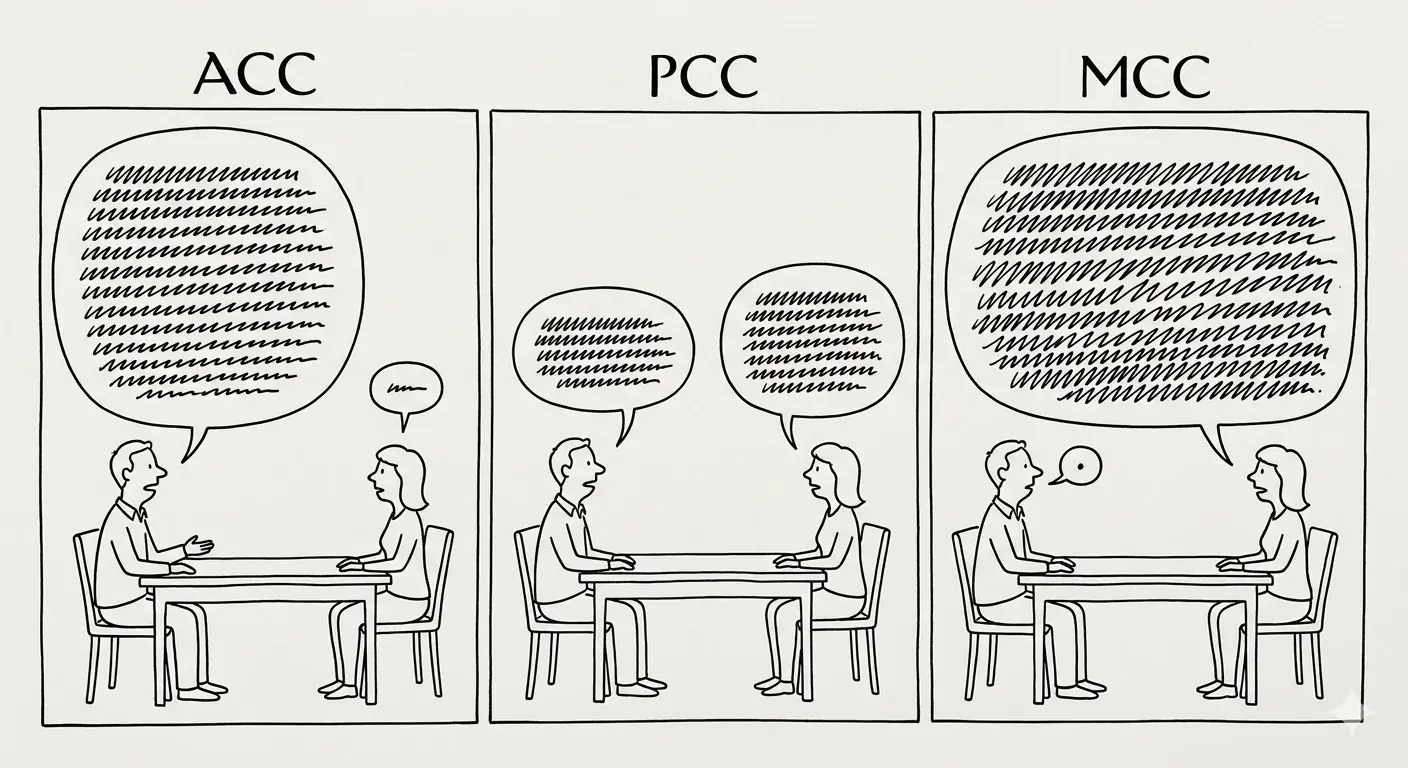
Silence. That's an observable behavior. They're not calling it "skillful use of space" or anything dressed up. They mean: does the coach shut up long enough to let something happen? If the recording is the coach talking every three seconds, that marker is probably not met.
And from "Evokes Awareness":
"Coach asks clear, direct, primarily open-ended questions, one at a time."
"Coach uses language that is generally clear and concise."
"One at a time" is the line I keep getting caught on. I have a habit of stacking two questions together in the same turn. "What do you mean by that, and how does that show up at work?" That feels like one thought to me in the moment. It's two questions. I've had to train myself to hear the second "and" coming and just stop.
None of these markers are hidden. None of them require decoding. They're sitting in a PDF on the ICF site and you can print them out. For most of the last few months, mine has been printed out on my desk.
Which session to submit
This is where the marker language should change how you think, and this is the part I've been wrestling with personally.
When I started recording sessions to prepare my MCC submission, my instinct was to reach for the sessions that felt most alive. The client had a moment. I asked something that landed. I left the call energized. Those felt like my best work.
I've since changed my mind. Those sessions weren't bad. The question the marker document carefully asks is: what did the coach DO in that session? If the moment happened because I offered a reframe the client hadn't articulated, or because I asked a question that contained a strong hypothesis, or because I stacked three observations together and the client said "oh, yeah," those are all things I did. They might have helped. They might have landed. But the markers don't care about impact. They care about whether my behavior matches the observable criteria.
The sessions I'm now looking at for my submission are the sparer ones. Where I asked short questions. Where I allowed silence that was long enough to feel a little uncomfortable. Where I reflected what the client said without embroidering it. Where the client was doing more of the talking than I was. Those sessions didn't feel dramatic when I did them. They also tick off marker after marker when I listen back, which turns out to be what matters here.
I'm not saying submit a boring session. I'm saying "the one that felt best" and "the one that meets the markers" are different questions. I started the process assuming they were the same question and they're not.
The new MSR documents are genuinely useful
A real piece of news for anyone preparing a submission in 2026 or later: on October 9, 2025, ICF released updated Minimum Skills Requirements documents for ACC and MCC credentials. They take effect for submissions on or after January 1, 2026. PCC skills themselves didn't change, but the document format is now standardized across all three levels. For the broader picture of what's changing across all three credential levels, the 2026-2027 credentialing changes are worth reading before you submit anything.
The format change is the interesting bit for candidates. The new MSR documents are explicitly structured as "Behaviors Consistent with ICF Standards" and "Behaviors Inconsistent with ICF Standards" at each level. In other words, they tell you what not to do, not just what to do.
This is practical. "Don't interpret for the client" is a clearer guide than "listen actively" because interpretation is an observable action you can catch yourself doing. If you're preparing, pull the MSR document for your level and read the Inconsistent list slowly. Then listen to your recording asking "did I do any of those?" That's a faster diagnostic than trying to score your session against 37 positive markers.
Listening back is the whole game
This is the part nobody wants to do, and it's the thing that helps the most.
For months now, I have been listening to recordings of my own coaching. It is not a fun activity. You hear yourself say things you'd swear you didn't say. You catch tics you didn't know you had. You notice, for the third time in fifteen minutes, that you asked a question that contained the answer. It is humbling in a specific way that I think only other coaches will recognize.
But here's what happens after a few weeks of this. Your ear changes. You start hearing things in real time that used to only show up on playback. You reach for a reframe in a live session and something in you says "wait, stop," and you stop. Your questions get shorter without you meaning for them to. The client fills more of the space, because you're leaving more of it empty.
That is the training input. Not the mentor sessions (though those matter). Not the MSR document (though read it). The thing that rewires your coaching is listening to your own recordings with the markers document next to you and checking off, plainly, what you did and didn't do.
A checklist that worked for me when I started this:
- Did I partner with the client to identify what they wanted to accomplish?
- Did I partner with the client to define what success looks like for this session?
- Were my questions open-ended, and were they one at a time?
- Did I allow silence, actual silence, long enough that the client filled it, not me?
- Did I add interpretation to what the client said, or did I reflect their words?
- Did I ask about their thinking, feelings, values, what they wanted, or did I steer toward solutions?
The recording I'm planning to submit is not one from when I started this process. It's a recent one, from after my ear had done a lot of work. If you're at the start, record anyway. The early recordings are not wasted; they're the training material that makes the later ones submittable.
A small move that helps more than you'd think
Get the transcript. Read it.
Audio is easy to fool. You know the sound of your own voice too well. You hear your coaching as "normal" and the patterns blur. But when you read a transcript silently, patterns jump out that you can't hear. You'll see how often you interrupted the client without meaning to. You'll see that some of your "questions" were really two or three questions bundled together. You'll see phrases you repeat. You'll see where the client was about to say something important and you came in with a reflection that cut them off.
A transcript of your own coaching is the single fastest diagnostic I know of for the patterns you can't hear. It's also free (any modern transcription service works) and it takes about twenty minutes to read one session.
A note on the self-doubt
I said at the top of this post that I'm about to submit my MCC application and I'm full of self-doubt. That's not a bit. That's where I am as I write this.
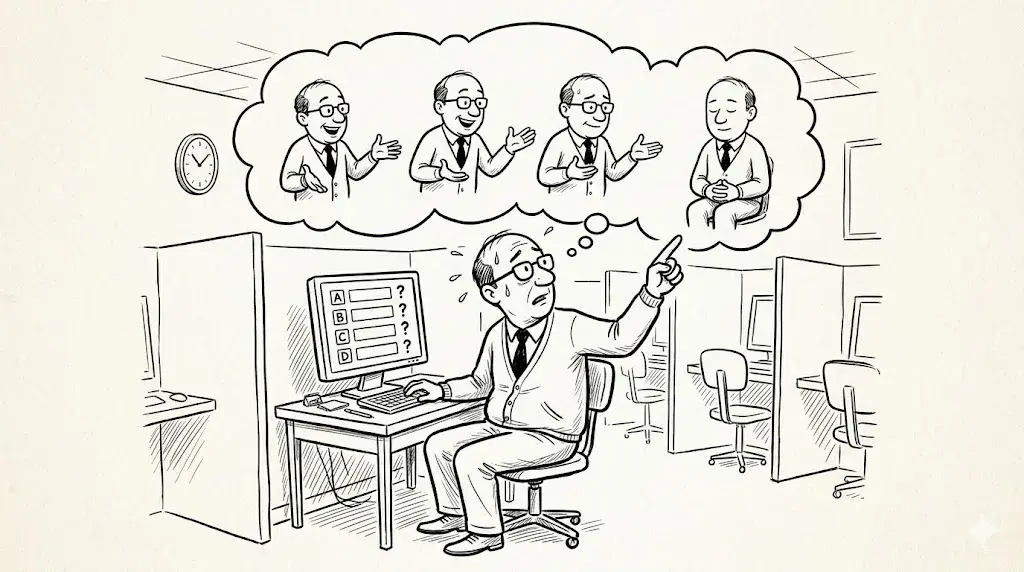
Here is what I think is happening. The more carefully you read the markers, and the more openly you listen to your own recordings, the more you see the gap between what you do and what the markers describe. That gap is real. It's also narrower than it feels when you're standing inside it. Your ear has gotten sharper faster than your coaching has changed, so for a while you're hearing all your imperfections and none of the progress, and it feels like you're getting worse.
I'm writing this partly for anyone who is in that same spot and wondering if they should wait another month. Maybe you should. But also, maybe the self-doubt is a sign that your ear is finally calibrated and the submission you're holding back is closer to ready than you feel. I don't know which one is true for you, and I don't know which one is true for me yet either. I'm going to submit anyway, because my mentor coach thinks I'm ready and I trust her more than I trust my own ear right now.
If you're somewhere in the middle of this and you don't have a human you trust listening to your recordings, that's the gap to close. Not more recordings, not more reading. A qualified mentor coach whose judgment you can lean on when your own stops being useful.
What CredentialPrep does here, specifically
I want to be direct about what the tool does and doesn't do, because there's a lot of "AI coach evaluator" stuff out there and I don't want to misrepresent what you'd get.
The actual problem it's solving, from my own experience preparing a submission: I have a pile of recordings. I've listened to some of them more than once. My ear is tired. I can't tell anymore whether the session I'm leaning toward is genuinely strong or whether I'm just used to it. I don't want to burn a mentor hour asking my mentor coach to listen to five mediocre recordings to help me pick one. I want to show up to her with a narrowed-down question.
That's what I use the transcript evaluation for. You paste in a transcript of a session and it reads it against the PCC markers at the level you choose (ACC or PCC), flagging which markers it sees evidence for and which it doesn't. It's a second set of eyes on a transcript, fast and repeatable. Run it on three or four of your own recordings and the pattern of what you do (and don't do) starts to show up.
What it is not: a replacement for mentor coaching. ICF requires 10 hours of mentor coaching from a qualified mentor coach, and the feedback from a human who has coached at your target level is irreplaceable. For a breakdown of what assessors are checking competency by competency and the most common submission mistakes, the performance evaluation guide covers it. My mentor coach catches things an algorithm can't. What CredentialPrep adds is volume between her sessions. You can run ten of your own recordings through it in a day, which isn't a thing you can reasonably ask a mentor coach to do without a serious bill.
It's also not the evaluation itself. ICF's performance evaluation is done by trained human assessors who hold a PCC or MCC credential. What CredentialPrep is doing is pressure-testing your transcript against the same published markers those assessors work from, before you submit.
One more thing worth mentioning: the app also has a simulated-client practice mode. When there's a specific kind of moment you keep fumbling (in my case, the end-of-session summary, which I have a hard time not making about me) you can drill that specific moment with a simulated client, over and over, without burning a real session. You can't ask a paying client to "let's do that again, but this time without the reframe." You can ask a simulated one.
The whole thing, compressed
- Read the ICF PCC Markers document. Read it slowly.
- Read the updated Minimum Skills Requirements document for your credential level. The Inconsistent-Behaviors list is where the fast learning lives.
- Record a bunch of your own sessions and listen back with the markers document in front of you.
- Read the transcripts of your sessions. Your ear lies to you; your eyes don't.
- The session to submit is probably the one where you talked little enough that the client did the work.
The credentialing path also includes the written exam, and it's worth starting exam practice earlier rather than later. You can start with 10 free questions right now, no card required: try it here
Sources
- ICF PCC Markers (November 2020). The primary document. Marker quotes in this post are cited from here.
- ICF Minimum Skills Requirements update, October 2025
- ICF Performance Evaluations overview
- ICF Core Competencies
- An unofficial transcription of the PCC markers by competency for when the ICF PDF is hard to read on mobile