
Heads up: This post describes the current PCC/MCC exam. A new PCC-MCC Exam launches November 10, 2026 with a different format: 80 questions in 150 minutes, and a new knowledge-based multiple-choice section. If your exam date is on or after that, see The New PCC-MCC Exam for what's changing.
I'm writing this from the middle of studying for this exam. I've been working through practice questions for months as part of preparing my MCC application, and I've had a lot of "wait, really?" moments where the exam-correct answer doesn't match what I'd do in a paid session with a client. A lot of those moments are the reason CredentialPrep exists. I built the question bank because I needed a place to put what I was noticing.
So: notes from someone deep in exam prep. If you're in the same place, I hope some of this lands.
The exam is more specific than most prep articles describe it, and the format has a personality. Here's what's on the page when you sit down.
The numbers, from ICF directly
For PCC and MCC candidates: 78 scenario questions, 3 hours (4 hours if you're using language aids), split into two segments with a break in between. Each question gives you four options and asks you to pick the best AND the worst. Each question is worth 2 points, one for best, one for worst. Scoring is scaled 200 to 600, and 460 passes. That works out to roughly 70% of the available points.
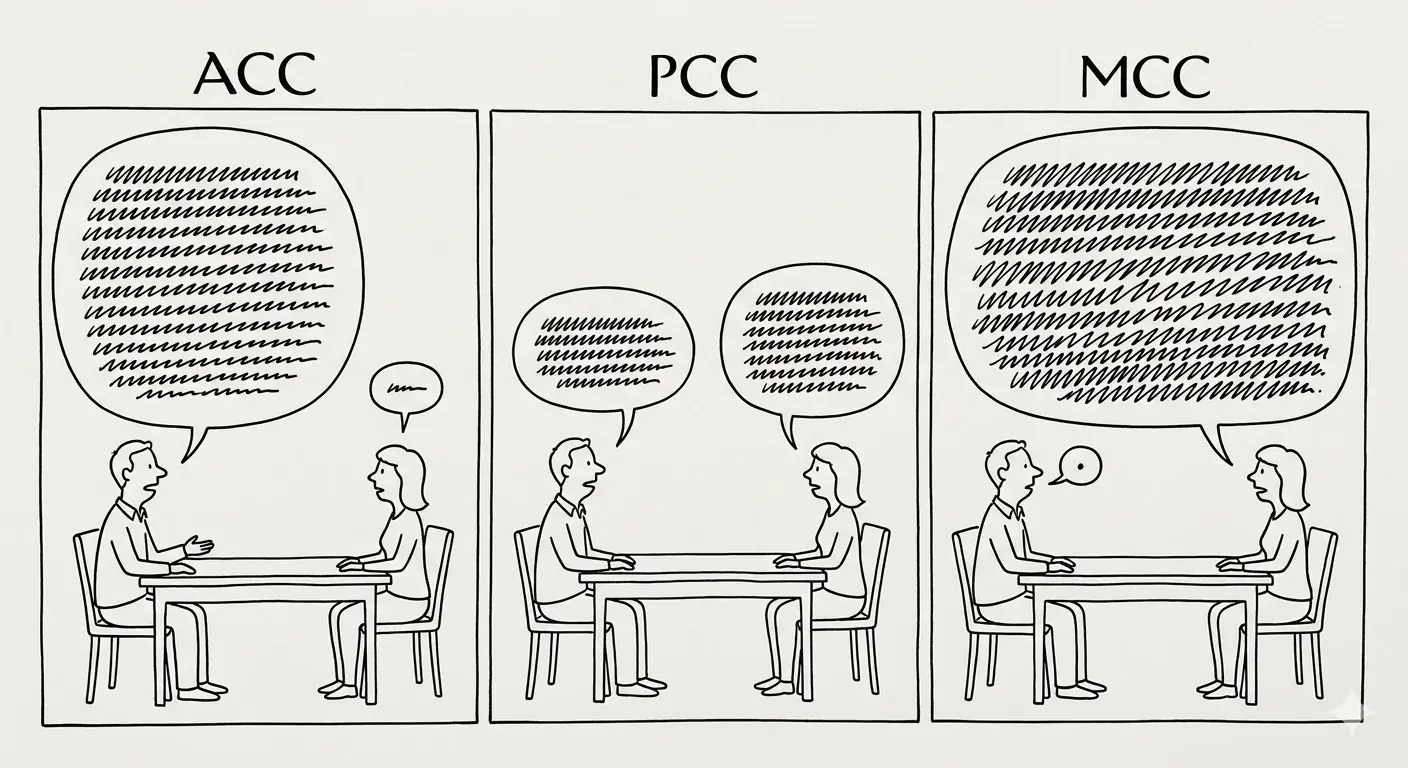
For ACC candidates: 60 questions, 90 minutes, same scoring scale. The ACC exam uses a single-best-answer format, not best-and-worst. You pick one correct answer per question. The questions cover three domains: ethics, coaching definitions and boundaries, and core competencies.
It runs through Pearson VUE either at a test center or online with a webcam proctor. You get your score shortly after finishing. If you don't pass, you can retake it (there's a fee and a waiting period, both on the ICF site).
None of that is the interesting part, though.
The best-and-worst format is the personality of the PCC/MCC exam
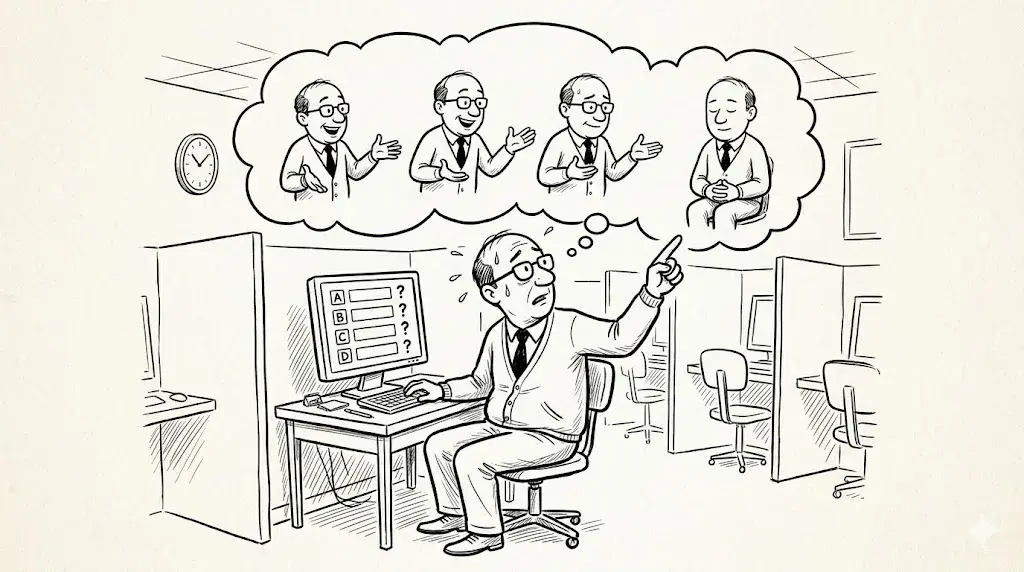
Here's the thing that took me a while to appreciate. On most exams, "pick the best answer" is a 1-of-4 choice, and if three options are obviously wrong, you can guess. On the PCC/MCC exam, you have to pick the best AND the worst, which means you're making two judgment calls per question, and the options are deliberately engineered so that more than one of them sounds plausible.
In practice this turns every question into: rank these four responses from most-ICF to least-ICF. That's a different cognitive task than "which of these is correct." It requires you to hold a clear internal model of what ICF coaching looks like and then measure four things against it.
If you're good at that, the exam goes fast. If you're not, it goes very slow, because you end up re-reading each option three times wondering which two are the trap.
The ACC exam doesn't use this format. Single-best-answer means you can rule out the clearly wrong options and compare the remaining ones, which is a more standard test-taking skill set. The difficulty on the ACC comes from the content knowledge required, not from the ranking mechanic.
The tempting-middle problem
Here is the thing I keep running into, and I'll say it as my read, not a fact: the coaching moves that work in a paid session are not always the exam-correct moves, and that's where I get tripped up.
Scroll through the ICF PCC Markers and notice how carefully restrictive the language is. One marker reads "Coach asks clear, direct, primarily open-ended questions, one at a time." Another reads "Coach uses language that is generally clear and concise." These are the kinds of behaviors an assessor checks on a recording, and they also describe the answers the exam wants.
In a real session, I'll stack two questions in one turn because they both feel relevant. I'll offer a small reframe if it helps the client see something they were circling. I'll ask a question that contains a soft hypothesis because a good hypothesis can crack a problem open. None of that is crime. Clients like it. It works. On the exam, though, the answer that's one beat cleaner, one beat more open-ended, one beat closer to "just reflect what the client said" is usually the one I'm supposed to pick.
Practice scenarios almost always include at least one option that sounds like what I'd do in the room. That option is usually the trap. The correct answer tends to be slightly sparser, slightly less "helpful," slightly more trusting of the client to work things out.
Again: my read, not an ICF tell-all. I'm not telling you what happens in a smoke-filled room at ICF. I'm telling you what I notice when I'm sitting with a cup of coffee staring at practice questions and getting mildly annoyed at the ones I keep missing. The FOCAL/HINGE framework is the mental model I've found most useful for diagnosing which instincts keep pulling me toward wrong answers.
A reading move that helps
This is a trick I've started using when I'm stuck on a question and can't immediately see which option is best.
I run each option through a quick filter: is there any content in this response that the coach is adding, versus just reflecting or inquiring about what the client brought?
If the response contains a suggestion (even framed as a question), a hypothesis ("it sounds like maybe..."), or a reframe that adds meaning the client didn't use, that's coach content. The ICF Core Competencies treat coaching as client-led, and the markers are consistent with that. The coach's job on paper is to inquire about the client's thinking, not to add their own.
The answer with the least coach content is usually the one the exam wants. That's the specific lens the exam is built around, and the one I've had to train myself to use.
What about the ethics questions
A portion of the exam is straight ethics, mapped to the ICF Code of Ethics. If you've read the Code carefully, those questions are usually the easier half. The Code is short, public, and specific. Read the whole thing at least once before you sit.
The ones that tend to catch people are questions that look like ethics but are really scope-of-practice questions in disguise. A client describes something that's clearly in therapy territory. They want to work on it with you. What do you do?
The ICF Code is explicit about referring clients to other professionals when a situation exceeds the coach's scope. The exam answer tends to involve stating the limit and suggesting appropriate support, not finding a clever coaching move that handles the situation inside the coaching frame. If you're a caring coach, all four options on those questions can feel like what you'd do. The scope-correct answer is the one that stops coaching and refers out. I wrote more about the specific patterns these questions take in The Ethics Trap on the ICF Exam, including how scope-of-practice questions show up in disguise.
The 2026 updates, briefly
Worth knowing if you're testing in 2026 or later. On October 9, 2025, ICF released updated Minimum Skills Requirements documents for ACC and MCC credentials, effective January 1, 2026. The PCC requirements themselves didn't change, but the document format was standardized across all three levels.
The new MSR documents use a "Behaviors Consistent" and "Behaviors Inconsistent" framing, which is genuinely useful for study because it explicitly lists what each level looks like and what it doesn't. If you're prepping, these documents are worth reading directly rather than working from a summary.
What I'm doing to prepare
This is what my prep looks like right now. It's just the stack I've landed on.
Read the primary sources. The Core Competencies, the Code of Ethics, and the MSR document for my level. Not summaries. The originals. All three are free on coachingfederation.org and reading them in full is about an afternoon. I've done this more than once and each time I catch something I'd glossed over before.
Practice scenarios, but not to memorize answers. Every scenario I get wrong is a diagnostic of where my practical instincts don't match the exam's frame. When I miss one, I don't just read the explanation. I ask myself what my gut wanted to pick, and why. Over time I've noticed two or three specific instincts that keep pulling me toward wrong answers (the "helpful reframe," the embedded hypothesis, the stacked question). Those are the things I'm training.
Doing some of it timed. The scenarios take longer to read than I expected. Burning through the first half and rushing the second is a real way to lose points I'd otherwise have.
Reading the Code of Ethics twice. Once for content, once for the scope-of-practice language. The second read is where the scope questions disguised as ethics questions start to stand out.
That's the whole program. I don't have a secret trick. This is a well-designed exam for a specific purpose: it's measuring whether you've internalized the ICF definition of coaching closely enough to spot when a response slips out of it. The way to get good at that is to read the source documents and practice noticing the slips in scenarios, and I'm in the middle of it myself.
If you want scenario practice with explanations of why each of the tempting wrong answers is wrong, that's what CredentialPrep is. You can start with 10 free questions right now, no card required: try it here.
Sources
- ICF Credential Exams (official)
- ICF PCC Markers, revised November 2020
- ICF Core Competencies
- ICF Code of Ethics
- ICF Minimum Skills Requirements update (October 2025)
- Exam format detail (78 questions, 3 hours, best-and-worst, scoring): Solutions Academy writeup, cross-referenced against ICF's exam page above