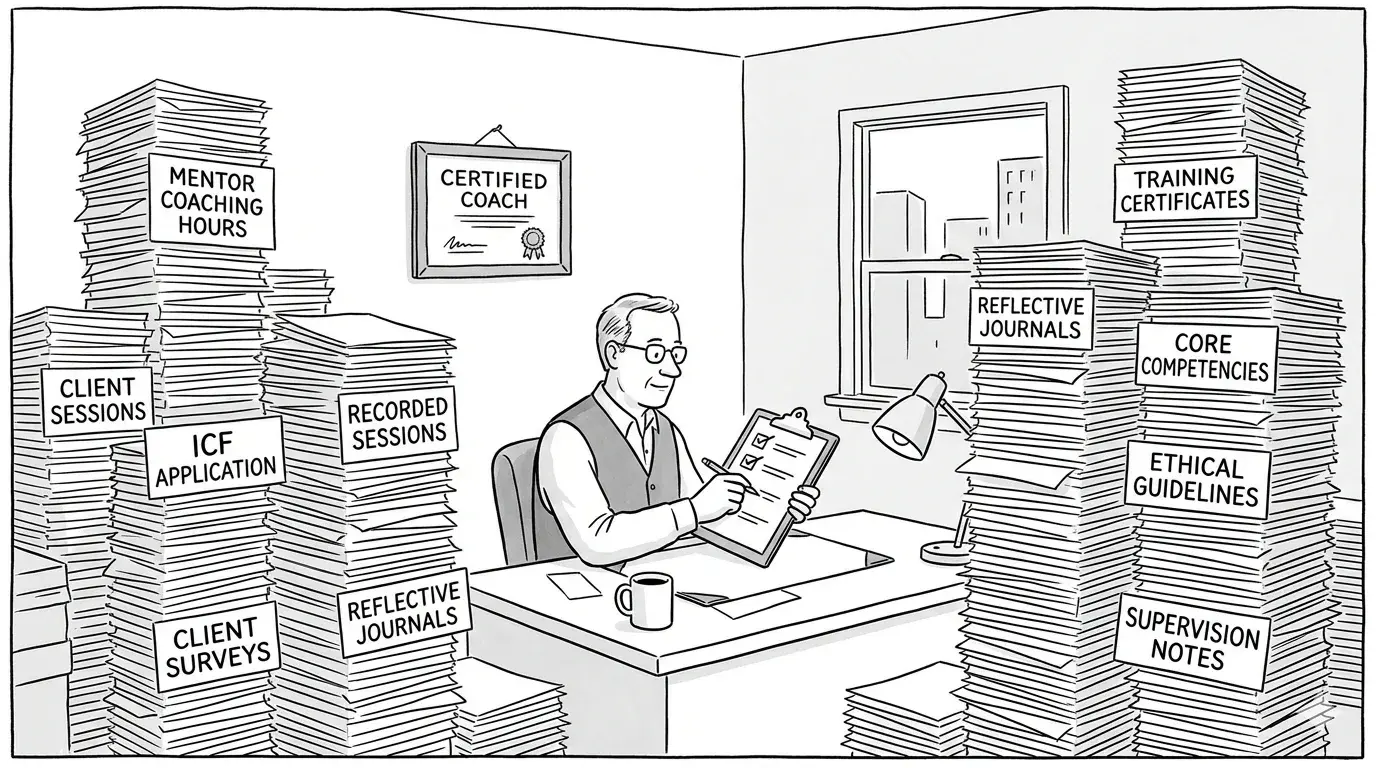

The written exam gets most of the attention when coaches are prepping for ICF credentialing. There are more resources for it, the format is clearer, and it has a score you get back right after sitting it. The performance evaluation is harder to prepare for, partly because feedback is slower and partly because it asks you to evaluate your own work against a framework that takes a while to internalize.
TL;DR
- A recorded coaching session is scored against the ICF markers for your credential level.
- Assessors check specific observable behaviors: clear agreements, questions over reframes, evidence of listening, engagement with emotion.
- A session can feel productive and still be thin on markers. A good feeling isn't the same as evidence.
- Read the markers, then score your own transcripts before submitting anything.
- Independent scoring by another calibrated reader is the most useful practice you can do.
This is what I've learned preparing my own MCC submission. A lot of it applies to PCC candidates too, because the underlying skill is the same: you have to be able to look at a coaching transcript and see what an assessor sees.
What the performance evaluation is
For PCC and MCC candidates, part of the credentialing process requires submitting a recording of a coaching session for evaluation. ICF assessors score the recording against the relevant set of competency markers: the PCC Markers for PCC candidates, and the MCC-level markers for MCC candidates.
The assessors are not listening for whether the session sounds impressive. They are checking specific, observable behaviors against a defined list. That distinction matters for how you prepare.
For ACC candidates, the performance evaluation requirement has a different pathway depending on how you're applying. If you're coming through an ACTP program, the evaluation is handled within the program. If you're applying through the portfolio path, check the current ICF requirements directly at coachingfederation.org, because these pathways and their specifics have changed over the years. The 2026-2027 credentialing changes cover what's different now and what's scheduled to change in April 2027.
What assessors are checking
The PCC Markers document lists observable behaviors for each of the eight core competencies. Each marker is a specific, behavioral description of what coaching at the PCC level looks like. Assessors mark whether evidence of each behavior is present in the recording.
A few things that come up repeatedly when coaches miss markers:
Agreements. The opening of a session is where many candidates lose points. If you don't establish a clear coaching agreement for this specific session, including what a successful outcome looks like for the client, the markers for Establishes and Maintains Agreements aren't well-evidenced. In practice, coaches often skip this because it can feel procedural. On a recording that's being evaluated, it's one of the first things an assessor checks.
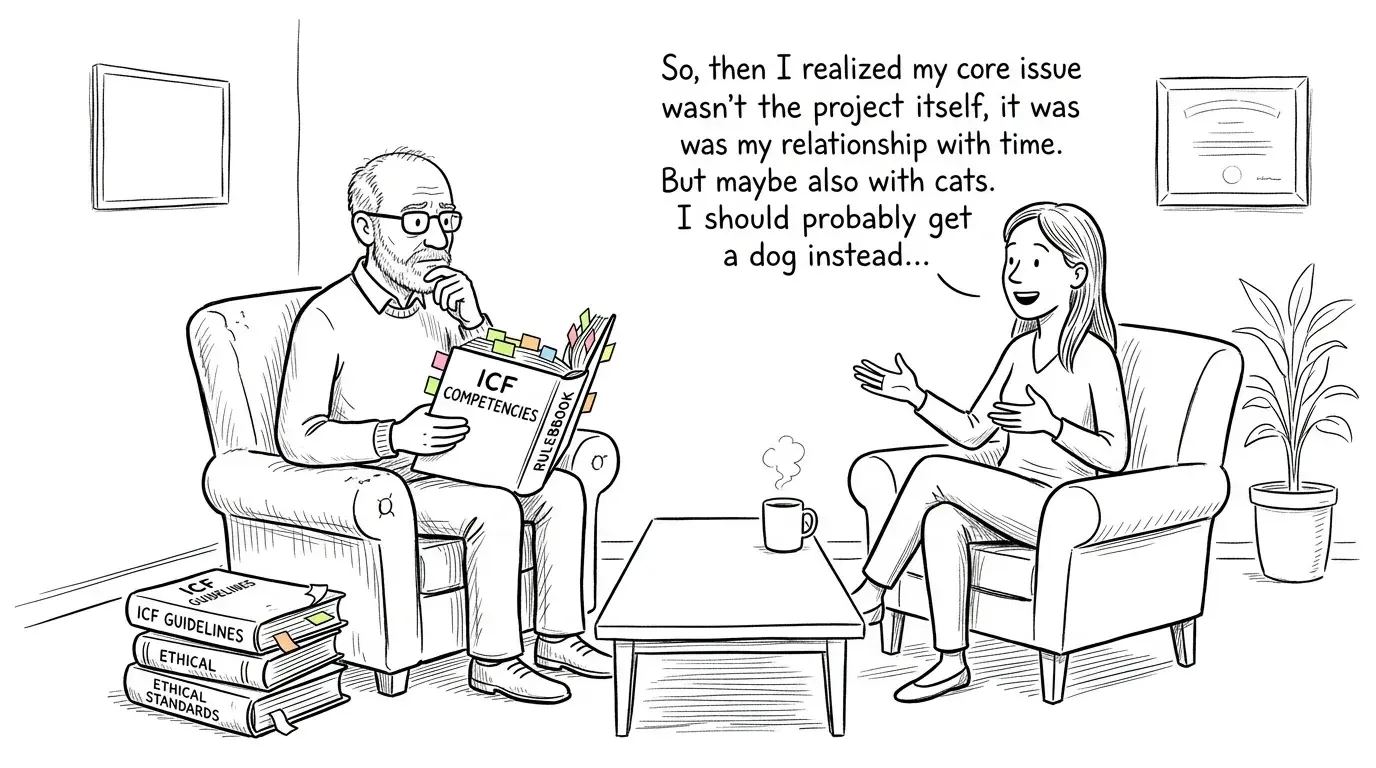
Questions vs. statements. The markers consistently describe the coach asking questions, not making observations or reframes. Coaches with years of practice have developed a habit of offering insight or perspective because it works in sessions and clients appreciate it. The markers, though, emphasize client-generated awareness. A response that sounds helpful but contains the coach's interpretation of the client's situation is often less well-scored than a cleaner question that hands the work back.
Listening evidence. The markers for Listens Actively don't just ask whether the coach listens. They ask whether there's observable evidence of it in the session: picking up exact language the client used, noticing what's not said, reflecting back in a way that shows you caught the nuance. In a recording, an assessor can't know what you're thinking. They can only hear what you say.
Emotions. Multiple markers across competencies involve the coach acknowledging or exploring the client's emotional state. Coaches who work primarily with executives or in professional settings sometimes steer around emotions because clients seem to want solutions. The markers don't give credit for reading the room that way. If emotion is in the session and the coach doesn't engage with it, that's a missed marker.
Common mistakes
Submitting a session you feel good about rather than one that demonstrates the markers. A session can feel like a genuine, connected, productive conversation and still be thin on specific markers. Feeling isn't enough. You need to look at the markers and find evidence.
Not reading the actual markers document. The PCC Markers are public, free, and specific. A lot of coaches prepare by reading about the competencies without reading the markers themselves. The markers are the scoring rubric. You need to know them.
Getting feedback from colleagues who aren't calibrated to the markers. Peer feedback on recordings is useful. Peer feedback from someone who hasn't studied the markers is useful for practice but not for calibration. The instinct "that felt good" and the assessor rubric don't always align.
Underestimating how different sessions are under review. When you're in a session, you have context, body language, the client's tone, and your own internal experience of what's happening. An assessor has a recording. What sounds like rich collaborative work in the room can read as fairly thin on a transcript if the coach's responses aren't specific and behavioral.
How to prepare
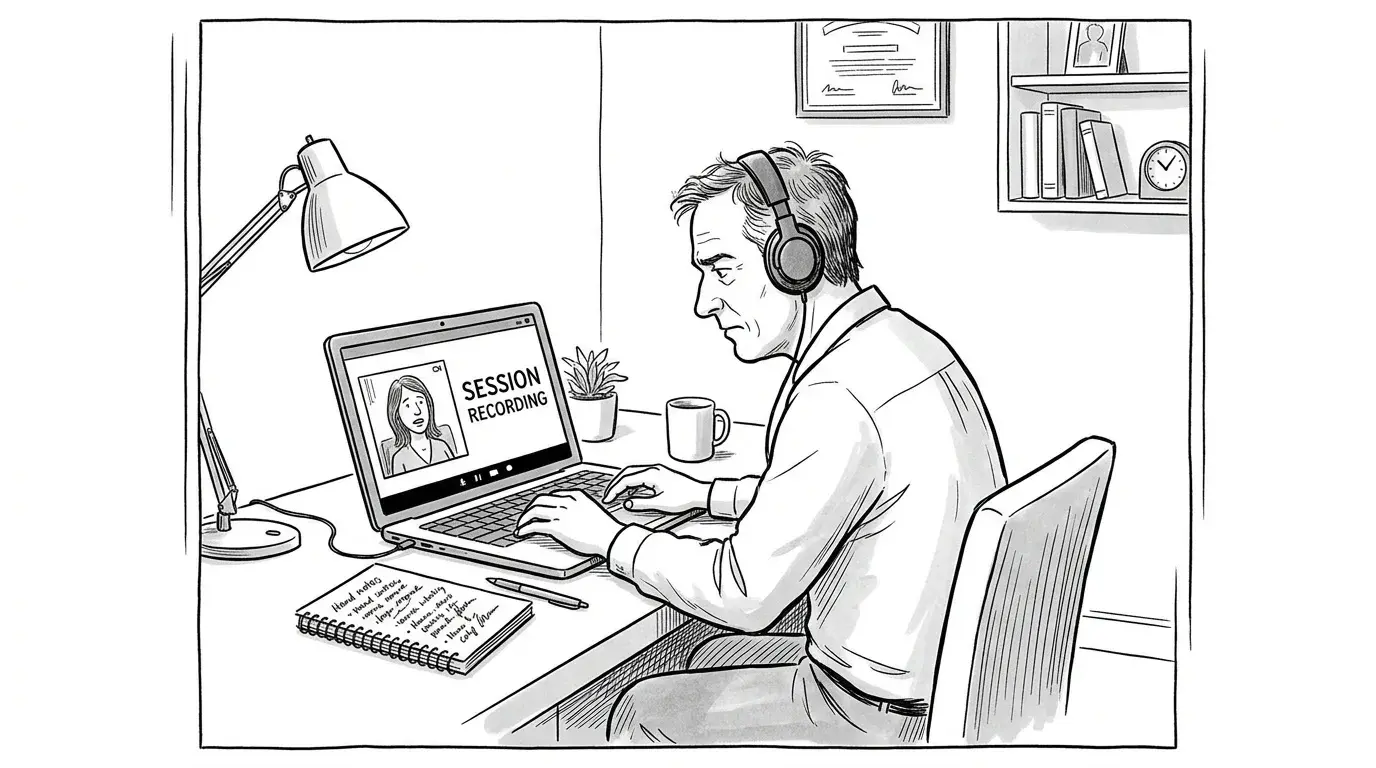
Read the PCC Markers until you can explain each one in concrete behavioral terms without looking. Then record a session, get a transcript, and score it yourself against the markers. Look for evidence of each behavior in the transcript, not in your memory of the session.
Do this multiple times. The first time is disorienting. By the third or fourth time, you start to see patterns in where you're generating evidence and where you're not. For a closer account of what that process feels like, including which sessions are worth choosing and how your ear changes over weeks of listening, What I Learned Preparing My MCC Submission walks through it in real time.
Having someone else score the same transcript independently and then comparing your scores is more valuable than almost anything else in preparation. Where you agree is confirmation. Where you disagree is the education.
Where CredentialPrep fits in
The transcript evaluation feature in CredentialPrep is built around this process. You paste a transcript, and it's scored against the ICF competency markers. You get marker-by-marker feedback, evidence pulled from the transcript itself, and a set of specific missed moments where the session could have gone differently.
A human assessor and a mentor coach are still what you need. What CredentialPrep gives you: scored feedback on a session quickly, without waiting, and without having to recruit another coach to review your work. I use it on my own transcripts as part of my MCC prep.
If you're preparing for the performance evaluation and you're not already scoring your own transcripts against the markers, that's the first thing worth fixing. The evaluation follows a public rubric that anyone can read in advance.
The written exam is a separate requirement from the performance evaluation, and both need attention. If you haven't started on the exam side yet, you can start with 10 free questions right now, no card required: try it here
Try the transcript evaluation feature with one of your own sessions. Free to start.