
Heads up: This post describes the current PCC/MCC exam. A new PCC-MCC Exam launches November 10, 2026 with a different format: 80 questions in 150 minutes, and a new knowledge-based multiple-choice section. If your exam date is on or after that, see The New PCC-MCC Exam for what's changing.
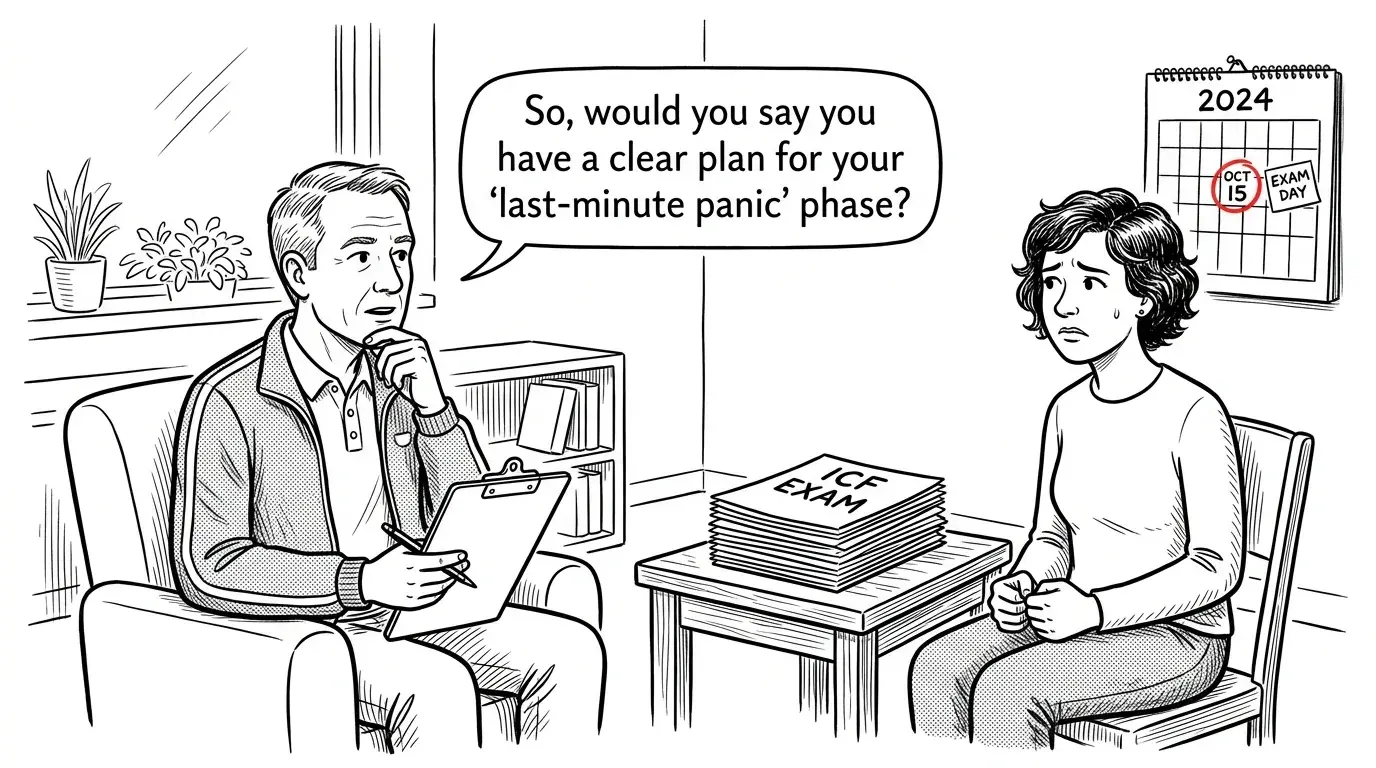
The content of the ICF credentialing exam is the competency framework. That part you either know or you're still building. But the strategy for how to navigate the exam itself is separable from the content, and it's worth thinking about before you sit down.
This is what I'd tell a coach sitting it in the next few months, based on what I've worked through while studying for my own exam as part of the MCC process.
Know your format before you walk in
PCC/MCC: 78 scenario-based questions, 3 hours, each asking for the BEST and WORST response from four options.
ACC: 60 scenario-based questions, 90 minutes, single-best-answer format (pick the ONE best response).
The format matters more than people expect because the best-and-worst structure is cognitively different from standard multiple choice. You're not just picking the right answer. You're ranking all four options, at least implicitly, to get both ends right. That takes longer per question.
For the PCC/MCC exam: 3 hours for 78 questions works out to about 2 minutes and 20 seconds per question. Some questions will be faster. Some will take 3 to 4 minutes. The margin isn't huge.
For the ACC exam: 90 minutes for 60 questions is 90 seconds per question. That's tight. Questions often include a scenario paragraph of 80 to 120 words followed by four options that each require a full read. You can't slow-walk this one.
Know these numbers before you sit, not while you're looking at the clock mid-exam.
Time management: the practical approach
The scenarios vary in complexity. Some will be clear within 30 seconds. Others will have two options that both look right, and you'll need time to untangle them.
A practical approach: read each question, pick your initial best and worst, and mark the ones you're unsure about. Keep moving. Go back to the flagged ones with whatever time you have left.
What doesn't work: spending 5 minutes on a hard question early in the exam and then rushing through everything else. The points per question are equal. Burning time on the ones that are genuinely hard at the expense of questions you could answer confidently is a bad trade.
Also worth knowing: the Pearson VUE platform has a flagging function. Use it. Don't try to hold "I need to come back to this" in your head while working through the rest of the exam.
The two-answer problem
The hardest questions are the ones where two options both seem defensible as the best answer. When that happens, the move is to flip it: start with the worst. I went deeper on why the worst-answer selection is its own skill in The Worst-Answer Problem.
The worst answer is often easier to identify with confidence. If you can lock in the worst, it usually clarifies the best because you've forced yourself to look at all four options through a cleaner lens. Sometimes identifying the worst also rules out the "almost right" option you were confused about, and the actual best becomes clear.
If you're stuck on both ends, go back to the core question: which option involves the least coach content and the most space for the client? Which option is the coach adding something versus taking from what the client brought?
The framework won't solve every hard question on its own. It works as a consistent tie-breaker.
Handling question drift
Here's a pattern worth knowing: after missing a few questions in a row or getting through a stretch of hard scenarios, there's a pull toward second-guessing the questions you already answered. Don't go back and change confident answers unless you have a specific, articulable reason.
Changing answers based on feeling shaky is more likely to hurt your score than help it. If you're reviewing a flagged question and you have a clear new reason to change your answer, change it. If you're changing it because you feel nervous, don't.
The exam is long enough that your energy will dip somewhere in the middle. That's when second-guessing kicks in. Having a rule about this ("I only change a flagged answer if I can say exactly why the original choice is wrong") keeps you from erasing correct answers.
The break (PCC/MCC exam)
The PCC/MCC exam has an optional break between the two segments. Take it.
Get up, walk around, eat something if you have food, step outside if you can. Your working memory is full and you've been holding a lot of attention for a long time. The break is not a sign that you need help. It's part of the exam design.
Using the break is not the same as losing momentum. Starting the second segment refreshed is worth more than being technically faster because you skipped it.
Ethics questions: a separate category
A meaningful portion of the exam tests the ICF Code of Ethics. These questions are usually more tractable than the competency scenarios, because the Code is specific and the answers tend to follow from reading it carefully.
Two things to know:
First, scope-of-practice questions often show up looking like ethics questions. A client describes something that goes beyond coaching. What do you do? The Code is explicit about referring clients to appropriate professionals. The answer that finds a creative coaching approach to stay in the conversation is almost always wrong.
Second, the Code's language around confidentiality has specific nuances, particularly around when confidentiality can be broken. Know those before you sit. They come up.
If you read the full Code of Ethics before your exam date, the ethics questions become the low-effort questions where you're not burning time or energy.
What to do the day before
Read the ICF Core Competencies once, slowly. Don't cram. You're not trying to memorize; you're refreshing your working model of what ICF coaching looks like so it's fresh.
Know where your testing center is, or have your remote proctoring setup confirmed. The Pearson VUE check-in process takes longer than expected, especially for online testing. The First 10 Minutes of the ICF Exam covers exactly what the setup and adjustment period looks like. Give yourself a real margin.
Don't do a heavy practice session the night before. Light review of areas where you've been getting questions wrong is fine. Grinding through 60 questions the night before is not fine.
The exam rewards consistency, not speed
Apply the same framework to every question with the same care. Don't let the hard questions rattle your approach to the straightforward ones.
Coaches who prepare systematically, practice scenario-based questions until they've identified and corrected their specific wrong-answer patterns, and walk in knowing the primary source documents in detail pass this exam. That's the whole program.
Practice ICF-style scenarios at CredentialPrep with explanations for every answer.