
I'm in the middle of my MCC application right now. Recording sessions, listening back, working with my mentor coach, reading the markers more times than I'd like. And in the middle of all that, ICF has announced a set of changes to how coaches earn credentials that are significant enough that I want to write about them clearly.
TL;DR
- April 1, 2027: the performance evaluation is replaced by enhanced mentor coaching for ACC and PCC Portfolio candidates. (Mentor coaches must hold the new Mentor Coach Specialization for any new mentor-coaching hours starting January 1, 2027, a related but separate deadline.)
- A mentor coach with the new Mentor Coach Qualification will decide when you're ready, not a single distant assessor.
- The new ACC exam (mandatory since March 2025) is knowledge-based: ethics 30%, definition 30%, competencies 40%.
- The PCC/MCC exam is in transition. ICF piloted a blended format in late 2025.
- Competencies were updated September 2025 and new Minimum Skills Requirements landed January 2026, though the exam still aligns to the 2019 framework.
Some of these changes are already in effect. Some kick in later this year. The biggest one doesn't land until April 1, 2027. But if you're preparing for a credential at any level right now, all of them are worth knowing.
The biggest change: the performance evaluation is being replaced
Starting April 1, 2027, ICF is eliminating the performance evaluation for ACC and PCC Portfolio path candidates. The current process (submit a recording of a coaching session, have it scored by trained ICF assessors) is being replaced by enhanced mentor coaching.
Instead of submitting a recording to an assessor you'll never meet, Portfolio path candidates will work with a mentor coach who holds a new Mentor Coach Qualification (MCQ). That mentor coach will observe multiple sessions over the course of the engagement, calibrate against the credential-level markers, and document skills demonstrated across the relationship. The mentor coach determines when you're ready.
ICF's stated reason: a single recorded session is an increasingly limited lens for evaluating coaching competence, especially across languages and cultures. A mentor coaching engagement spread over time gives a fuller, more contextual picture.
For MCC candidates: this specific change applies to ACC and PCC Portfolio path candidates only. MCC has a separate path with its own requirements. Check coachingfederation.org directly for the current MCC standards.
What this means for how you prepare
Here's the thing that landed for me when I read through the announcement. The performance evaluation used to be one high-stakes moment: one recording, scored by an assessor you'd never interact with again. That's stressful, but it's also bounded. You prepare a recording, submit it, wait.
The new model puts even more weight on the mentor coaching relationship. Your mentor coach now holds the keys. They're not just helping you get ready anymore. They're the ones who decide you're ready. That changes the stakes of every session you have with them.
Which means showing up to those sessions having already done the self-work matters more than it ever did.
Mentor coaching is expensive. Most coaches get the minimum 10 required hours and not much more. If you're spending those hours showing your mentor coach the same patterns you could have identified yourself: stacking questions, not allowing silence, interpreting instead of asking. That's a slow way to get through the process.
The coaches who get the most out of their mentor coaching are the ones who show up already having diagnosed their own gaps. Who bring a specific question. Who've already done the work on their recordings between sessions and are coming in with targeted evidence that they've changed something.
That's where the volume work lives. Not in the mentor sessions. In everything that happens between them.
The ACC exam has already changed
If you're an ACC candidate, this is the change that's most immediately relevant because it's already done. The new ACC exam format became mandatory in March 2025.
The new exam explicitly defines three content domains with published percentage weightings:
- Coaching Ethics: 30%
- Definition and Boundaries of Coaching: 30%
- Coaching Competencies, Strategies, and Techniques: 40%
That's a different split from the older exam formats and a different emphasis. Ethics and definition make up 60% combined. The competencies domain at 40% is still the largest single area, but it's not dominant the way some candidates assume coming in.
The new ACC exam is knowledge-based. You're not selecting best-and-worst answers from a scenario the way PCC and MCC candidates are. You're demonstrating that you know the framework, the definitions, the ethical obligations, and the distinctions between coaching and other modalities. That's a specific kind of preparation. For a detailed breakdown of how the exam format works and what the best-and-worst question structure is actually testing, What the ICF Credentialing Exam Really Tests covers both ACC and PCC/MCC formats.
The PCC and MCC exam is also in transition. ICF piloted a blended format in December 2025 that mixes knowledge-based questions alongside the situational judgment items, and that format is now finalized: it launches November 10, 2026. See The New PCC-MCC Exam for the full breakdown of what's changing and how to tell which format your exam date falls under.
The competencies were updated in 2025
In September 2025, ICF released updated Core Competency documents. The eight competency names are the same. What changed: five new sub-competencies were added, eleven existing ones were revised, and ICF published a new glossary of terms for the first time.
Important caveat for exam prep: the credentialing exam is still aligned with the 2019 competency framework. The 2025 updates don't affect what the exam tests, at least for now. But the updated sub-competencies and the glossary are the current standard for everything else: mentor coaching evaluation, your own practice, any feedback you get on recordings.
If you're working with a mentor coach, they're calibrating to the 2025 documents. Worth reading them alongside the older markers you may have been using.
Updated Minimum Skills Requirements
As of January 1, 2026, ICF updated the Minimum Skills Requirements for ACC and MCC credentials. The format is now standardized across all three credential levels.
What's useful about the new MSR documents is their structure. They explicitly spell out both "behaviors consistent with ICF standards" and "behaviors inconsistent with ICF standards" at each level. The inconsistent-behaviors list is practical in a way that the positive markers aren't always, because it tells you exactly what not to do.
If you haven't read the MSR document for your credential level lately, it's worth pulling the current version. The language is more specific than what was there before.
What stays the same
The exam is still the exam. The written exam isn't going away. ACC, PCC, and MCC candidates still sit a credentialing exam as part of the application process. The fundamental structure of credentialing (coaching hours, mentor coaching hours, exam, demonstrated coaching competency) is the same. ICF is updating the way competency is evaluated, not eliminating the standard.
The eight core competencies are still the eight core competencies.
How I'm thinking about this for my own prep
I'm mid-MCC process and a lot of this affects me directly. My mentor coach is expensive, brilliant, and doesn't have unlimited time for my recordings. What I've been doing: using transcript evaluation between our sessions to identify the patterns I'm still repeating, so when I sit down with her I'm not bringing her something I could have diagnosed myself.
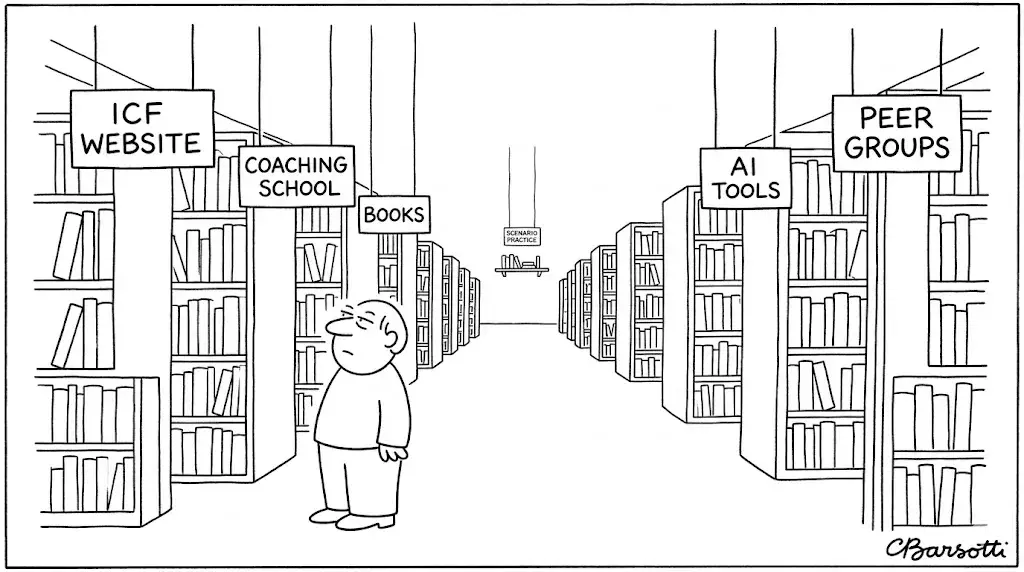
That's the loop I'd suggest for anyone working toward a credential under the new model. Use whatever you have access to for volume work between mentor sessions: your own ear, tools that score transcripts against the markers, simulated practice for the moments you keep fumbling. Show up to your mentor coach with specific questions. Make those hours count.
If you want to understand what that self-work looks like on the performance evaluation side, The ICF Performance Evaluation Guide goes through what assessors are checking and how to score your own recordings before you submit.
The mentor coach is the relationship that matters most under the new system. Prepare accordingly.
If scenario practice is part of your prep, you can start with 10 free questions right now, no card required: try it here.