
Heads up: This post describes the current PCC/MCC exam. A new PCC-MCC Exam launches November 10, 2026 with a different format: 80 questions in 150 minutes, and a new knowledge-based multiple-choice section. If your exam date is on or after that, see The New PCC-MCC Exam for what's changing.
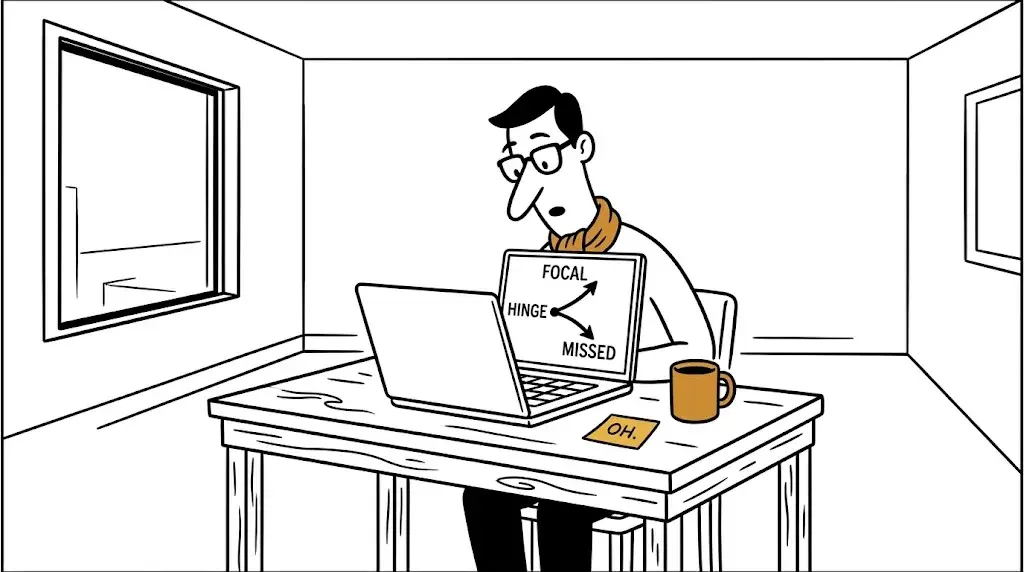
I've been studying for the ICF credentialing exam for a while now. I hold my PCC and I'm preparing my MCC application, which means the exam is something I'm actively working toward, not something I've already cleared. While doing that, I built a framework I call FOCAL/HINGE for reading any scenario question quickly. More on that below.
One of the first things I noticed: the way most coaches study for this exam doesn't match what the exam tests.
The exam is 78 questions, three hours, best-and-worst format. You're given a coaching scenario and four possible responses. You pick the one that's most effective and the one that's least effective. There's no memorization, no definitions to recall. It's a judgment test, start to finish.
So when coaches study by reading the eight core competencies over and over, or making flashcards of the PCC Markers, they're preparing for a different exam. That knowledge is still valuable. But reading about "maintains presence" is not the same as recognizing which of four responses demonstrates it under pressure.
The question isn't what the competency means. The question is: which of these four responses reflects it in action?
What the exam is testing
Every scenario question is testing the same underlying thing: is the coach staying with the client, or are they doing something else?
"Something else" covers a lot of ground. Giving advice. Making assumptions. Evaluating the client's insight. Directing them toward a conclusion. Praising their progress. Not being transparent when they should be.
Good coaching keeps the client doing the work. The coach is present, curious, asking, listening without judgment, and creating space for the client to think. The exam rewards responses that do that.
Bad coaching interrupts the client's thinking. The coach takes over. They impose a direction, nudge the client toward a specific answer, grade the client's insight, lecture them about what's happening, or hide their real agenda.
Most candidates know this in the abstract. The hard part is applying it quickly, under pressure, across 78 questions in three hours.
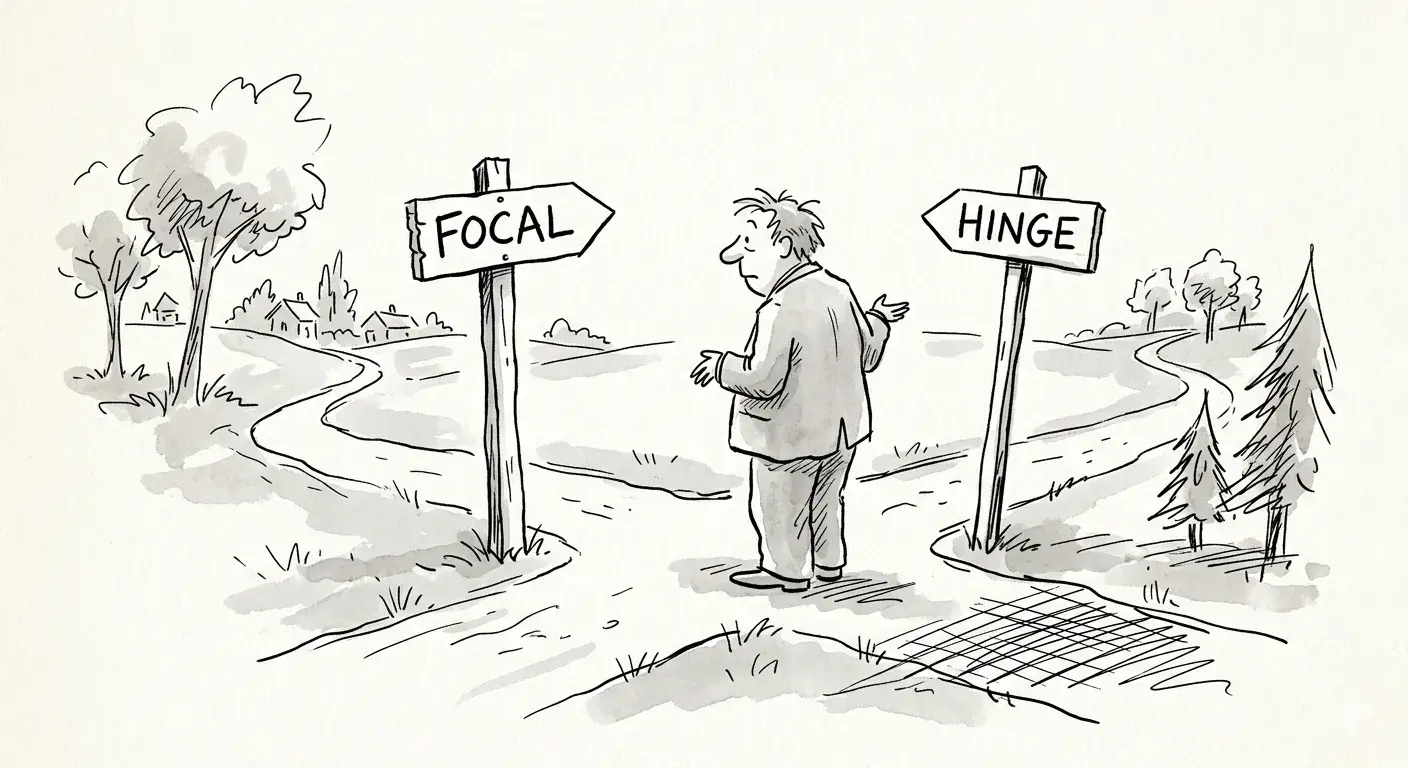
FOCAL and HINGE
I built a framework to make this faster. It's two mnemonics: one for best answers, one for worst. Each letter maps to a specific behavior you can look for in an answer choice.
FOCAL: what best answers do:
- F: Follow the client's lead. The response stays with where the client is going, not where the coach wants to take them.
- O: Open up the space. The response creates room to explore rather than closing things down.
- C: Curious. The response comes from curiosity, not assumption.
- A: Ask rather than tell. Questions over statements.
- L: Listen without judgment. No evaluation of what the client said, just engagement with it.
HINGE: what worst answers do:
- H: Hide. The coach withholds something, their real agenda or a relevant observation, instead of being transparent.
- I: Impose. The coach imposes their direction. They steer the client toward a particular conclusion.
- N: Nudge. The coach nudges the client toward a specific answer rather than letting them find their own.
- G: Grade. The coach evaluates or judges the client's thinking, insight, or emotional state.
- E: Explain. The coach explains, lectures, or teaches. They take on the role of expert.
The logic: best answers are FOCAL. Worst answers make everything HINGE on the coach.
A sample question
Here's what this looks like in practice.
Your client is a senior manager who has been talking for the past few minutes about feeling like a fraud at work. She says: "I know I should just push through it, but lately I feel like everyone can see I don't know what I'm doing."
Which of the following responses would be MOST effective?
A. "That sounds really difficult. What do you think is sitting underneath that feeling?"
B. "A lot of high achievers experience this. It's sometimes called impostor syndrome, and it doesn't mean you're underperforming."
C. "It sounds like you're being quite hard on yourself. What would it look like to give yourself more credit?"
D. "I hear you saying you feel like a fraud. What does pushing through it really mean to you?"
Apply FOCAL to each response:
Option A: "That sounds really difficult. What do you think is sitting underneath that feeling?"
Acknowledges what the client said (L: listening), then opens with a question (A: ask, O: open, C: curious). But look at the phrase "sitting underneath that feeling." That's the coach's framing, not the client's language. It's subtly directing the client toward introspection rather than following where the client is.
Option B: "A lot of high achievers experience this. It's sometimes called impostor syndrome..."
The coach introduces a framework the client didn't ask for (E: explain). They're teaching. They also make an assumption about the client's performance ("doesn't mean you're underperforming") and ignore the client's experience by imposing their interpretation (I: ignore). This is a HINGE response.
Option C: "It sounds like you're being quite hard on yourself. What would it look like to give yourself more credit?"
The coach interprets ("being quite hard on yourself") and then steers toward a specific direction: self-compassion and self-credit (N: nudge, I: ignore). The follow-up question is leading. The coach has already decided where this should go.
Option D: "I hear you saying you feel like a fraud. What does pushing through it really mean to you?"
The coach reflects the client's exact words back without reframing them. Then asks a question using the client's own language: "pushing through it" is what the client said, not what the coach brought in (F: follow, O: open, A: ask). No coaching agenda, no new framing, no direction.
Best: D. Worst: B.
Why the hard ones are hard
Notice that A and C are plausible-sounding responses. Option A seems empathetic and curious. Option C seems supportive. Neither feels obviously wrong in real life.
But the exam is asking whether a response reflects ICF-aligned coaching, staying with the client's frame rather than substituting the coach's, more than whether it's kind or useful in isolation.
Option A introduces "sitting underneath that feeling," the coach's metaphor, not the client's. It's a small move, but it's the coach's move. Option D just reflects "feel like a fraud" back, verbatim, and then picks up the client's own thread: "pushing through it."
FOCAL and HINGE give you a fast filter. When you read a response and spot G (grading), E (explaining), or I (ignoring), that's a HINGE response. When you see F (following), O (opening), A (asking), it's moving toward FOCAL.
Most wrong answers on this exam look helpful from the outside. The tell is inside: whose thinking is driving this response?
How to use this in your prep
This framework works best as a diagnostic, not a formula. You still need to know the competencies. You still need to understand what "active listening" and "evoking awareness" look like in practice, not just what they're called.
But when you're in front of a question and two answers both seem reasonable, FOCAL/HINGE gives you a way to separate them. Write it at the top of your scratch paper before the exam starts. Use it when you're stuck.
I've been building this framework into CredentialPrep, a practice tool I've been developing while preparing for my own MCC application. It's got scenario-based questions for ACC and PCC/MCC levels, with transcript evaluation against the ICF markers. If you want to practice applying FOCAL/HINGE to more questions, it's at credentialprep.com. There's a free tier.
And if you have questions about this framework or the exam in general, feel free to reach out. I'm in the middle of this process too.