
Heads up: This post describes the current PCC/MCC exam. A new PCC-MCC Exam launches November 10, 2026 with a different format: 80 questions in 150 minutes, and a new knowledge-based multiple-choice section. If your exam date is on or after that, see The New PCC-MCC Exam for what's changing.
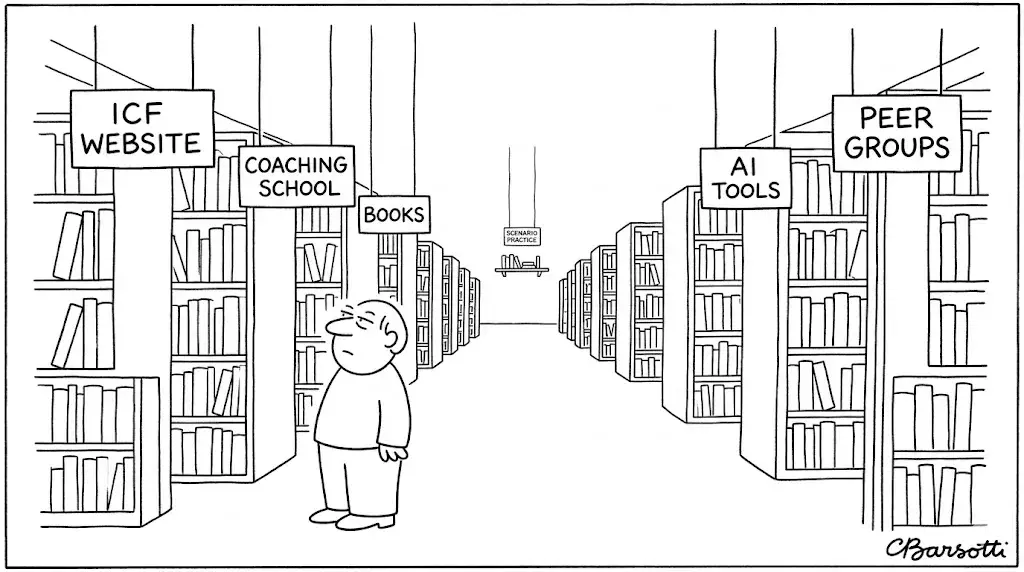
If you're preparing for the ICF credentialing exam and you've started Googling for resources, you've probably noticed that the landscape is scattered. There's no official prep course, no single textbook, and a lot of advice that amounts to "read the competencies and good luck."
TL;DR
- There are now two written exams: the ACC Exam (60 questions, single best answer) and the ICF Credentialing Exam for PCC/MCC (78 scenarios, best-and-worst).
- ICF's free materials are the source of truth, but their official sample bank is tiny: 10 questions for ACC, 8 for PCC/MCC.
- Books like Stoltzfus's "Coaching Questions" build conceptual depth; they don't replace practice in the actual exam format.
- The under-served gap is scenario practice with explanations. CredentialPrep is built for that gap.
- General-purpose AI can supplement, but consistency varies. Peer groups work when they debate scenarios, not theory.
This guide covers every meaningful prep option available in 2026, what each one is good for, and where each one falls short. The goal is to help you build a study plan that maps to what the exam tests, not just what's easy to find.
Two Exams, Not One
Before reviewing resources, it helps to understand that there are now two separate written exams in the ICF credentialing process. The old Coach Knowledge Assessment (CKA) was retired around 2022 and has been replaced.
The ACC Exam (launched late 2024) is a 60-question knowledge-based test. Single best answer, 90 minutes. It covers Coaching Ethics, Definition and Boundaries of Coaching, and Coaching Competencies. The format is straightforward multiple choice.
The ICF Credentialing Exam is what PCC and MCC candidates take. 78 situational judgment items, 3-hour time limit. Each question presents a realistic coaching scenario with four options, and you select both the best and worst response. Both selections count toward your score.
Both exams are administered by Pearson VUE, either at a testing center or via remote proctoring.
This matters for how you prepare. The ACC Exam tests whether you know the ICF model. The ICF Credentialing Exam tests whether you can apply it under ambiguity, where two answers both look reasonable and you have to know which one ICF would rank higher.
ICF's Own Materials
What's there: ICF publishes the Core Competencies document and the Code of Ethics, both freely available on their website. They also publish the PCC Markers, which describe specific observable behaviors that assessors look for in coaching recordings. Candidate guides for ACC, PCC, and MCC are available as PDFs and include exam structure details.
For practice, ICF publishes 10 official sample questions for the ACC Exam and 8 official sample questions for the ICF Credentialing Exam. That's the complete public question bank from ICF. There's also a free Pearson VUE tutorial that simulates the exam interface.
What it's good for: This is the source of truth. Everything in both exams derives from the ICF competency model, so these documents should be the foundation of any prep plan. Free and authoritative.
Where it falls short: Ten questions and eight questions don't give you enough practice to build pattern recognition. The official materials tell you what will be tested, but they don't give you much opportunity to practice being tested. That gap is where most candidates need outside resources.
Coaching School Prep Programs
What's there: Many ICF-accredited coaching programs include some level of credentialing exam prep, either as part of the core curriculum or as an add-on module. The quality varies significantly by school. Some programs run dedicated exam prep workshops. Others include it briefly at the end of the program. A few have built standalone prep courses available to alumni.
What it's good for: If your school has a strong exam prep component, this is worth taking seriously. The instructors typically know the ICF framework deeply and can contextualize the exam content within the coaching model you already learned.
Where it falls short: Availability is inconsistent. If you trained at a school that doesn't offer dedicated exam prep, or if you're approaching your renewal and the school program is no longer accessible, you'll need to supplement elsewhere. School-based prep also tends to be expensive if purchased separately after graduation.
Books and Study Guides
A handful of books are worth reading in the context of ICF exam prep, though none of them were written specifically as exam prep tools.
"Coaching Questions" by Tony Stoltzfus is frequently recommended because it builds fluency with the kinds of questions ICF's model rewards. It won't teach the competencies directly, but it deepens understanding of what good coaching looks like in practice.
"Co-Active Coaching" by Kimsey-House et al. is a foundational text that overlaps significantly with ICF's competency model. Reading it carefully builds conceptual grounding, even if the specific language doesn't map one-to-one to the ICF framework.
ICF-specific study guides do exist in small quantities, typically self-published by coaches who've been through the credentialing process. Quality varies. Some are genuinely useful. Others are thin. Before purchasing any, look for sample questions that reflect the actual exam format: scenario-based, four options, requiring applied judgment.
The limitation of books: Books build conceptual understanding. They don't build applied judgment, and they can't replace practicing the actual format the exam uses.
Practice Question Resources
This is the area of the prep landscape most candidates feel is under-served, and they're right. Given that the exam is scenario-based and requires applied judgment, the most effective prep is working through scenarios repeatedly, with feedback on where your reasoning diverged from the ICF model.
credentialprep.com is a tool built specifically for this gap. It offers scenario-based practice questions modeled on the ICF Core Competency framework, with explanations for each answer that walk through the ICF reasoning. The question bank covers both ACC and PCC/MCC level content. It's available free to start, with more practice volume available on paid tiers. The explanations are the more valuable piece, since understanding why the wrong answers are wrong is where most of the learning happens. It also includes a transcript evaluation feature where you can submit coaching session transcripts for AI feedback on how well your coaching reflects the ICF competencies, which is a useful study tool separate from the official ICF performance evaluation process.
Other practice test providers: A small number of independent exam prep providers offer ICF question banks, typically as part of broader prep packages. Before purchasing, evaluate whether the practice questions reflect the actual exam format. Some providers offer knowledge-recall questions (definitions, true/false) that don't reflect how the ICF Credentialing Exam works. For the PCC/MCC exam, look specifically for scenario-based questions with four response options in best-and-worst format. For the ACC Exam, knowledge-style questions with one correct answer are appropriate.
ICF's own sample questions: ICF publishes 10 sample questions for the ACC Exam and 8 for the ICF Credentialing Exam on their website. These are worth working through carefully, both for the content and to calibrate what each exam format looks like.
AI Tools for ICF Exam Prep
AI tools have become a meaningful part of how candidates study, with a few important caveats.
General-purpose AI assistants (ChatGPT, Claude, Gemini) can generate scenario-based practice questions if prompted well, explain ICF competencies in different ways, and give feedback on practice responses. This can be genuinely useful for filling in conceptual gaps or generating additional practice volume.
The limitation is consistency. Without a curated question bank built specifically around the ICF framework, the quality and accuracy of AI-generated scenarios varies. You can get good practice material, but you can also get scenarios that don't accurately reflect ICF's model or exam format. Using AI to supplement structured practice is reasonable; relying on it as the primary prep tool is risky.
credentialprep.com uses AI to generate questions within a structured framework built around the ICF competencies, which addresses the consistency problem. The questions are grounded in the actual competency model rather than a general-purpose language model's interpretation of it.
Peer Study Groups
Many candidates prepare in peer groups, either through their coaching school alumni networks, through ICF chapter communities, or through informal connections made during training. This can be effective for discussing competency nuances, working through scenario-based questions together, and building confidence before the exam.
The effectiveness of a study group depends almost entirely on the quality of the discussion. Groups that work through scenarios and debate reasoning tend to be more useful than groups that discuss the theory. If you can find a group of three to five people with similar prep goals and a willingness to engage with practice questions seriously, this is worth doing alongside other resources.
How to Build a Study Plan That Works
The prep sequence depends on which exam you're taking.
For the ACC Exam: start with the ICF Core Competencies document and the Code of Ethics. Read them carefully, not quickly. Understand what each competency is and what it looks like in practice. Then work through knowledge-based practice questions to test your understanding. The ACC Exam is testing whether you know the model, so that's what you're building.
For the ICF Credentialing Exam (PCC/MCC): read the Core Competencies, then read the PCC Markers. The markers are more granular and describe specifically what PCC-level coaching behavior looks like. Then move to scenario-based practice with the best-and-worst format. This is where most people under-invest. The goal is pattern recognition: learning how ICF distinguishes good coaching from the best response in ambiguous situations.
For both exams, use books and peer discussion to deepen your conceptual understanding alongside practice questions. And give yourself enough time. Compressing prep into a few weeks of heavy reading is a common approach that often doesn't work.
Bottom Line
The two ICF written exams test different things. The ACC Exam tests knowledge of the ICF model. The ICF Credentialing Exam for PCC and MCC tests applied judgment under ambiguity. The prep strategy that works for one is not identical to the prep strategy that works for the other.
ICF's own materials are essential and free, but the official sample question banks are small (10 questions for ACC, 8 for PCC/MCC). For volume, you need outside resources. Your coaching school's prep content is worth using if it's available. Books build conceptual depth. Peer groups can sharpen your thinking. And for scenario-based practice aligned to the actual exam formats, credentialprep.com addresses the gap most candidates feel most acutely going into the exam.
The candidates who pass are usually the ones who combined deep familiarity with the ICF model with enough practice to recognize the right answer under pressure. Both parts matter.