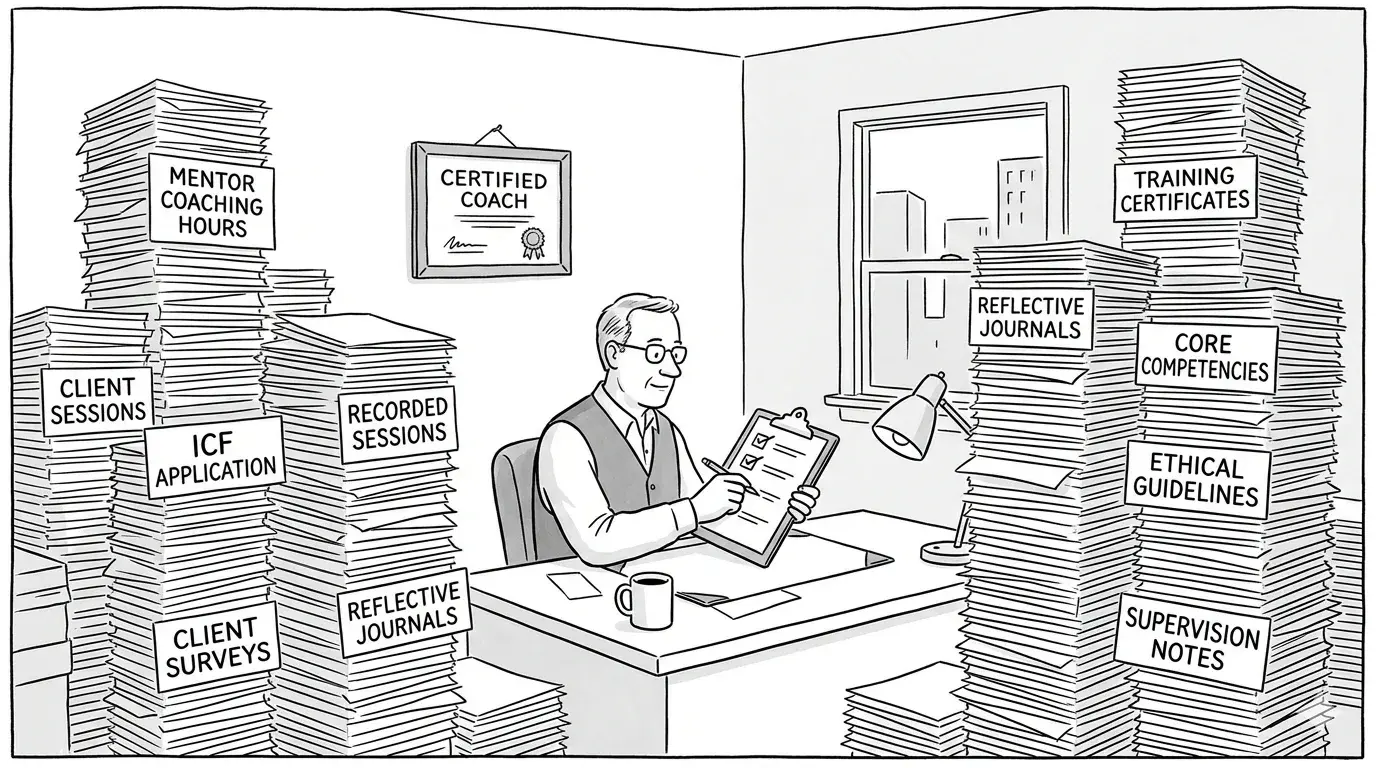

The 8 ICF Core Competencies are the framework behind both the written credentialing exam and the performance evaluation. Most coaches know the names. Fewer have a clear picture of what each one looks like, moment by moment, in a conversation.
TL;DR
- The 8 competencies leave specific, observable evidence in a transcript. Knowing the names isn't the same as finding the evidence.
- Common misses: vague session agreements, paraphrasing the client's words, and questions that carry the coach's hypothesis.
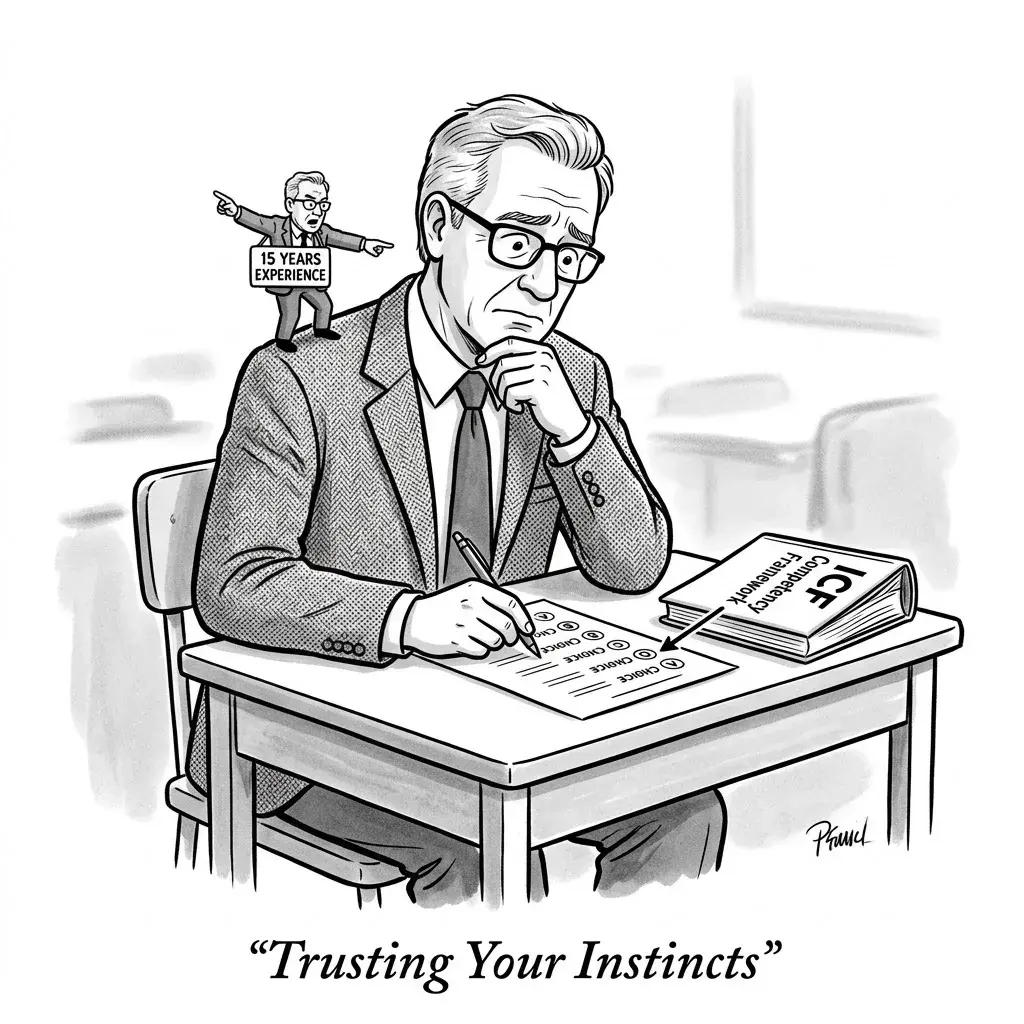
- Strong real-world instincts toward reframes and insight often miss markers that a cleaner question would have evidenced.
- Score your own transcripts against the markers, looking for evidence behavior by behavior.
- Where your scoring and a calibrated reader's diverge is where the actual learning is.
This is the gap that makes performance evaluation preparation harder than it needs to be. "Maintains Presence" means something specific and observable. "Listens Actively" leaves evidence in the transcript. Knowing what to look for changes how you review your own recordings.
These are my working notes, built from studying the ICF Core Competencies and the PCC Markers alongside my own recordings. I'm preparing my MCC submission, so I've been doing this exercise on my own work for a while. I wrote about that process in ICF Session Evaluation: What I Learned Preparing My MCC Submission.
1. Demonstrates Ethical Practice
In a session, this shows up as transparency about what coaching is and isn't, maintaining appropriate confidentiality, and recognizing when a client's situation goes beyond the scope of coaching.
The observable moment that assessors look for: when something arises in a session that edges toward therapy, medical, or legal territory, does the coach name that boundary and refer appropriately? Or does the coach find a coaching angle to stay in the conversation?
The coaching angle is usually wrong. The competency is about knowing and working within the limits of coaching, not finding creative ways to stay in a conversation that should probably be handed off.
In practical terms: if a client mentions persistent anxiety, complicated grief, or something that sounds like it needs professional support outside coaching, the marker is evidenced by the coach naming that observation and raising appropriate referral, not by the coach continuing to explore it through a coaching frame.
2. Embodies a Coaching Mindset
This is one of the harder competencies to see in a transcript because a lot of it is about orientation rather than behavior. The markers describe a coach who is curious, open, and approaches the client as capable and whole.
What you can see in a transcript: whether the coach is asking questions from genuine curiosity about the client's experience, or whether the questions are leading somewhere the coach has already decided matters. The language of the questions carries this. "What do you notice about that?" feels different from "Have you thought about what that might mean for your relationship with authority?"
The second example is still a question, but the coach's hypothesis is loaded into it. An assessor reading the transcript can often feel the difference, and the PCC Markers describe the coach "trusting the client's process" and "demonstrates openness to not knowing."
3. Establishes and Maintains Agreements
This is one of the most commonly under-evidenced competencies in recordings I've reviewed, including my own.
The visible moment: the coach and client explicitly establish what success looks like for this session before the coaching begins. Not just "what do you want to work on?" but something specific enough that by the end of the session, both people could say whether they got there.
The maintenance part shows up mid-session: if the client takes the conversation somewhere new, does the coach check in about whether to follow that direction or stay with the original topic? Both choices are fine. The marker is evidenced when the coach makes that choice consciously and in partnership with the client.
Coaches who open sessions with "so what's on your mind today?" and then follow wherever it goes are often not evidencing this competency clearly, even if the session itself is useful.
4. Cultivates Trust and Safety
Evidence in a transcript: the coach uses the client's exact language rather than paraphrasing into the coach's preferred terms. The coach acknowledges the client's experience before moving forward. The coach doesn't rush past emotion.
What this looks like concretely: a client says "I feel like I've been spinning my wheels for months." An assessor is checking whether the coach picks up that language. A response like "say more about spinning your wheels" evidences this competency. A response like "so you've been feeling stuck in your progress" is a paraphrase that replaces the client's image with the coach's.
The distinction sounds small. In a recording, it shows up across many exchanges, and a consistent pattern of paraphrasing away from the client's language reads as the coach subtly directing the conversation toward the coach's framing.
5. Maintains Presence
This one is partly about what the coach doesn't do. Presence is evidenced by responses that show the coach was tracking what the client said rather than preparing the next question.
Responses that demonstrate presence: reflecting something specific from what was just said, noticing a change in the client's energy or direction, sitting with silence before responding.
What undermines presence in a transcript: pivoting to a new angle immediately after the client finishes speaking (suggests the coach wasn't fully in the client's experience), asking a question that's a slight variation on the previous one (suggests the coach wasn't integrating the client's answer), and generally moving fast through topics.
Silence is presence. The transcript won't show you silence, which is why the recording is submitted and not just the transcript. But everything around a silence does show up.
6. Listens Actively
This competency leaves specific evidence. The markers describe the coach reflecting back what they heard, noticing what wasn't said, and distinguishing between the client's words and what those words might mean.
Evidence in a session: the coach uses exact phrases the client used, not close synonyms. The coach names what seems to be underneath the surface of what the client is saying ("I notice you described this situation three times as unfair, I'm curious what that word is carrying"). The coach catches when the client says something that seems to contradict something said earlier and opens it up with curiosity rather than moving past it.
Where this breaks down: coaches who listen well in the room but paraphrase everything into cleaner language. The markers reward the client's language being honored, not improved.
7. Evokes Awareness
This is the competency that rewards patient questions over clever interventions.
Evidence: the coach asks questions that cause the client to think, not questions that invite the client to confirm what the coach suspects. The client says something new, has a moment of insight, or names something they hadn't named before.
What undermines this: questions that contain the answer. "Do you think you might be avoiding this because it feels risky?" is a less strong evidence of Evokes Awareness than "what do you make of the fact that you keep circling back to this?" The first question tells the client what to think and then asks if they agree. The second one opens space for the client to find something.
This competency is where coaches who are intellectually engaged with their clients' situations can do too much. The insight belongs to the client. The coach's job is to create the conditions for it.
8. Facilitates Client Growth
This is about the end of the session and what comes after. The markers describe the client identifying next steps, the coach supporting accountability in a way that fits the client, and the client having something concrete to take forward.
What it looks like: the coach doesn't produce the action plan. The client does. The coach's role is to help the client get specific ("by when, and what would getting started look like?") without prescribing the answer.
A common miss: the session ends with the client feeling good and energized, but with a vague intention rather than a concrete commitment. "I'm going to think about how to approach that conversation" is different from "I'm going to draft the first two sentences of that email before Thursday and see what that surfaces."
The difference is specificity, and it comes from the coach pushing gently toward concreteness without making the decision for the client.
Using this to review your own recordings
The practical version of this exercise: take a transcript of one of your sessions and go through it with the markers document open. For each competency, find the evidence that's there and notice where there isn't any.
The gaps are usually consistent. Most coaches have two or three places where their instincts don't align with the markers. Finding them in your own work before you submit a recording is the whole point of this kind of preparation.
CredentialPrep's transcript evaluation feature is built around this process. You paste a transcript and get scored feedback against the ICF competency markers, with specific evidence cited from your actual session. It's how I've been reviewing my own work for the MCC process. For more on what the full performance evaluation process involves, How to Prepare for the ICF Performance Evaluation covers the submission requirements and what assessors are looking for.
Try it with your own transcript and see where your evidence is strong and where it's thin.