
Heads up: This post describes the current PCC/MCC exam. A new PCC-MCC Exam launches November 10, 2026 with a different format: 80 questions in 150 minutes, and a new knowledge-based multiple-choice section. If your exam date is on or after that, see The New PCC-MCC Exam for what's changing.
Yesterday morning I got a PCC practice question wrong before I'd finished my coffee.
I'd already worked through fifteen of them. On this one I felt confident before I clicked submit. Two of the four options looked obviously wrong to me, and between the two that remained I picked the one that felt warmer. It was the second-best option. The right answer was the other one.
That moment of "wait, why" is where most of my real learning in this prep has happened. Not from re-reading the eight core competencies. From the small gap between what I thought I was doing in that answer and what the framework says I was doing.
The hard part is spotting the gap fast enough to use it before I move on to the next question.
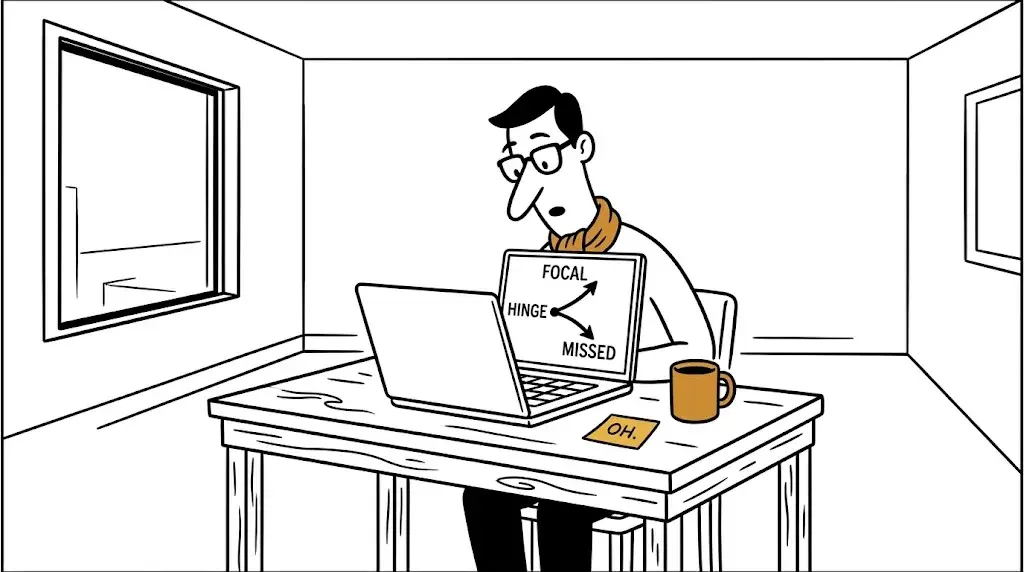
That is what FOCAL/HINGE in the debrief is for.
What the annotation does
I wrote about FOCAL and HINGE in an earlier post. Two mnemonics, one for what best answers do, one for what worst answers do. Useful for studying. Less useful in the moment right after you've answered a question and you're trying to figure out which kind of "right" you missed.
So I put the annotation directly into the debrief on every PCC and MCC question. After you submit, the debrief shows two things at the top:
- The best answer with the FOCAL letters that applied to it, and one sentence on which behaviors made it FOCAL.
- The worst answer with the HINGE letters that applied to it, and one sentence on which behaviors made it HINGE.
Not a lecture. A label and a sentence.
The point is this: when you missed by picking A instead of D, you can read "Option D is FOCAL because it Follows the client's exact words and Asks them to define their own uncertainty," and go, oh. That's the thing I didn't see.
What it looks like
Take a question like this:
A client has spent five minutes describing a conflict with a coworker. They sound frustrated. They end by saying: "I just don't know what to do."
Which of the following responses would be MOST effective?
A. "What feels most important to address first?"
B. "What have you tried so far?"
C. "It sounds like you're feeling stuck. What would unstuck look like?"
D. "What do you mean when you say you don't know what to do?"
I picked A. It sounded like a coaching move, the kind that hands the priority back to the client.
The best answer was D. Submit, debrief loads, FOCAL/HINGE annotation reads:
Best: D (Follows, Asks). Option D is FOCAL because it Follows the client's exact words ("don't know what to do") and Asks them to define their own uncertainty.
Worst: C (Ignores, Grades). Option C is a HINGE because it Ignores what the client said by imposing the frame of "stuck" and Grades the client's experience by treating "unstuck" as the goal they should be working toward.
And there it is. A bypasses what the client said. They said "I don't know what to do." A skips past that and asks them to prioritize instead. D takes those exact words and hands them back. That's the difference between bypassing the client and honoring what they brought.
Two letters and one sentence told me what twenty minutes of staring at four options wouldn't have.
Why this beats reading more theory
Reading "Maintains Presence" gives you a category. The example above shows what the annotation does that reading can't: it names the specific behavior that made D right. "Follows, Asks" is more useful than "Maintains Presence" in the moment after you missed, because it's the behavior, not the category.
That's what the mnemonic is for: not a study guide you read once, but a vocabulary for your errors. After a few weeks of debriefing questions this way, you stop missing the same type twice because you can name it.
What it doesn't do
The annotation is a label, not a verdict. There are scenarios where what separates "best" from "second-best" comes down to the specific situation in the prompt, not the FOCAL/HINGE letters alone. The debrief still has the longer written explanation underneath, which is where the situational reasoning lives.
The letters are a fast filter. They name the type of error. The longer explanation says why that type of error matters in this specific scenario.
I built it this way because that's how I study now. A quick read on the type of mistake I just made, then a slower read on why the mistake matters here.
If you're prepping for the PCC or MCC exam and want to try this on real practice questions, CredentialPrep is at credentialprep.com. The free tier gives you ten questions, which is enough to see what the annotation looks like in the debrief. PCC and MCC questions all have FOCAL/HINGE on them.
If you've got feedback on the format, send it over. I'm using these debriefs myself while I prep my MCC application, so anything that makes the labels sharper or the explanations cleaner is worth knowing.