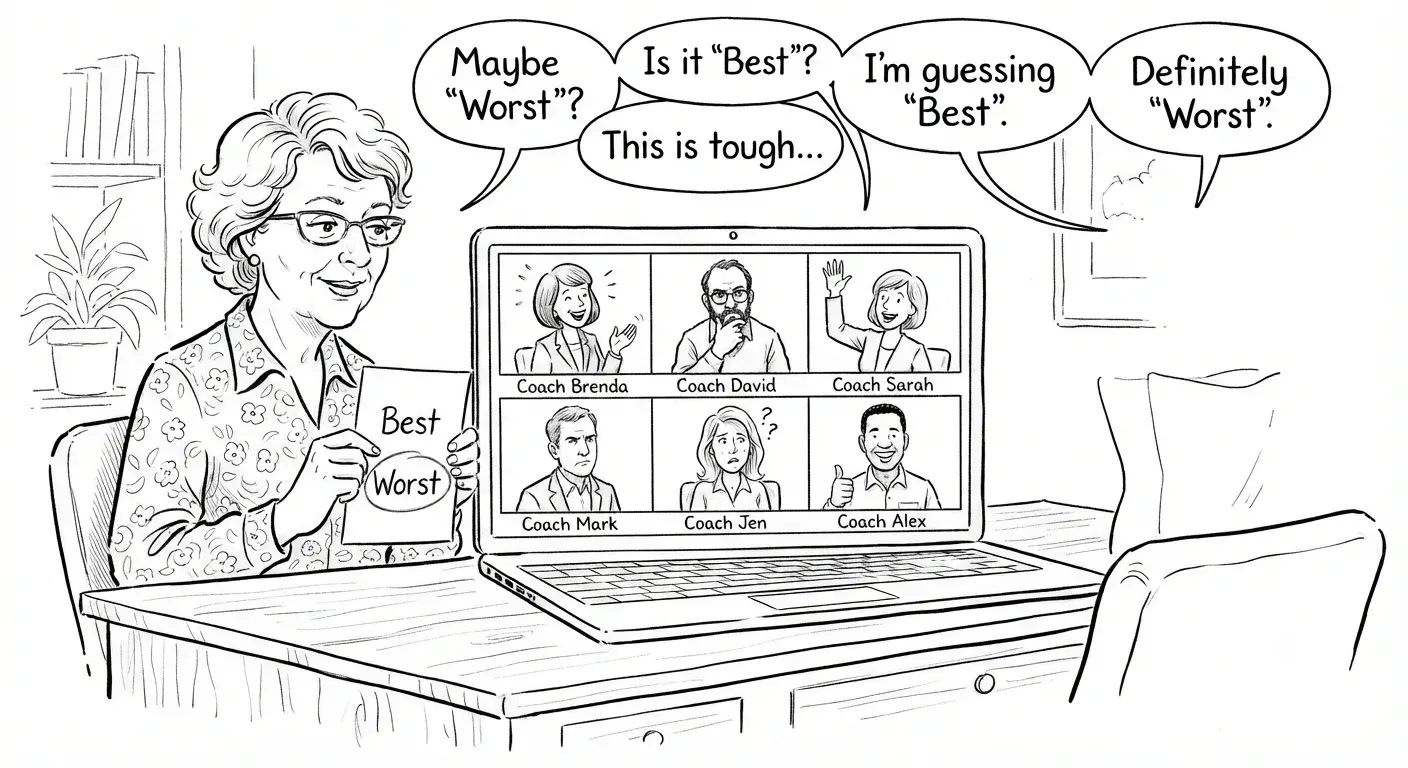

I've been running live PCC exam prep sessions on Zoom, and posting the recordings to a YouTube channel afterward. A small group each time, usually four to eight coaches, all somewhere between "I signed up for the exam last week" and "I take it next Tuesday." We read scenario questions together, guess at the best and worst answers, and talk through our reasoning out loud, disagreements included.
The recordings live here: CredentialPrep on YouTube. If you can't make it live, or you're studying at a weird hour from somewhere across the world, the recordings are the next-best thing. If you want to sit in on one, keep reading. I'll say how to join at the end.
I told the group upfront on the first session that I'm not a master of this exam. I built CredentialPrep because I'd spent enough on my own credentialing path and didn't feel like paying for another course. So we do what I think works: read real scenario questions together and argue about the tricky ones. Nobody grades anyone. It's practice.
What tends to come up
Watching a few of these back, the same patterns keep showing up:
The client-centered versus coach-centered lens does most of the work. The pattern that keeps surfacing is simple to say and hard to apply under pressure. You have to check whether the answer is led by what the client needs, or by what the coach thinks, feels, or wants to prove. One coach in an early session picked out acknowledgment language as her tell for a strong answer. Another caught the assumption buried in a seemingly caring response. Both were reading for the same thing from different angles.
Coaches trip over their own good intentions. The instinct several of us have, myself included, is to ask more questions before saying anything. But the ICF's logic is often more direct. If you've noticed something, your job is to say it, not sit on it and investigate first.
Not every wrong answer is wrong for the same reason. Sometimes a coach's suggestion is worse than another coach's leading question. Sometimes it's the other way around. The exam wants you to look past the verb and into what the coach is doing.
Confidentiality has almost no gray area. Most PCC questions live in genuine gray area. When one doesn't, and the answer is unusually rigid, it's useful to feel that difference in real time.
Sometimes I disagree with the answer key. In one recent session, I flat-out disagreed with an ethics scenario, and the group went with me. That kind of pushback is part of the practice. If you can articulate why an answer feels off, you're building the muscle the exam is testing.
Recent recordings
The channel has them all. If you want a specific taste, the July 17 session has five questions including an ethics scenario I argue with the answer key on. The July 10 session has seven coaches working through four questions including the confidentiality one.
A session like this can't be replaced by practice questions, even good ones. Hearing other people's reasoning out loud, disagreements and all, is a different learning experience than reading an explanation.
How to sit in on one
I don't run these on a set schedule. I announce the next one when I've scheduled it. Register for a free CredentialPrep account and you'll get an email when there's one coming up: try it here. No card required.
If you want the fuller picture of what the ICF Credentialing Exam tests (the 8 ICF Core Competencies and their sub-behaviors, not PCC markers, which is a separate thing used for the performance evaluation, not the exam), here's a breakdown of the exam format. And if you're wondering whether PCC and MCC candidates sit for a different test, the short answer is no, they don't.
Why I keep doing these
A PCC candidate who joined an early session said something that stuck with me. She'd sat through a lot of exam prep sessions, and this was the first one where hearing other people's reasoning out loud, disagreements and all, helped her more than another explanation would have. In her words:
"I visited a lot of such meetings, and this one without any hesitation, was the best one. If we can do it again, I'm in. Like for 100% in."
- Nina B., PCC candidate
That's why I keep doing them. If you're studying and want to try the same kind of practice on your own, CredentialPrep has scenario questions with full explanations, and you can start with 10 free questions right now, no card required: try it here.
And if something in any of the recordings made you think "wait, I would have picked differently," reply to this post or reach out. I'd like to hear your reasoning. That disagreement is usually where the learning is.